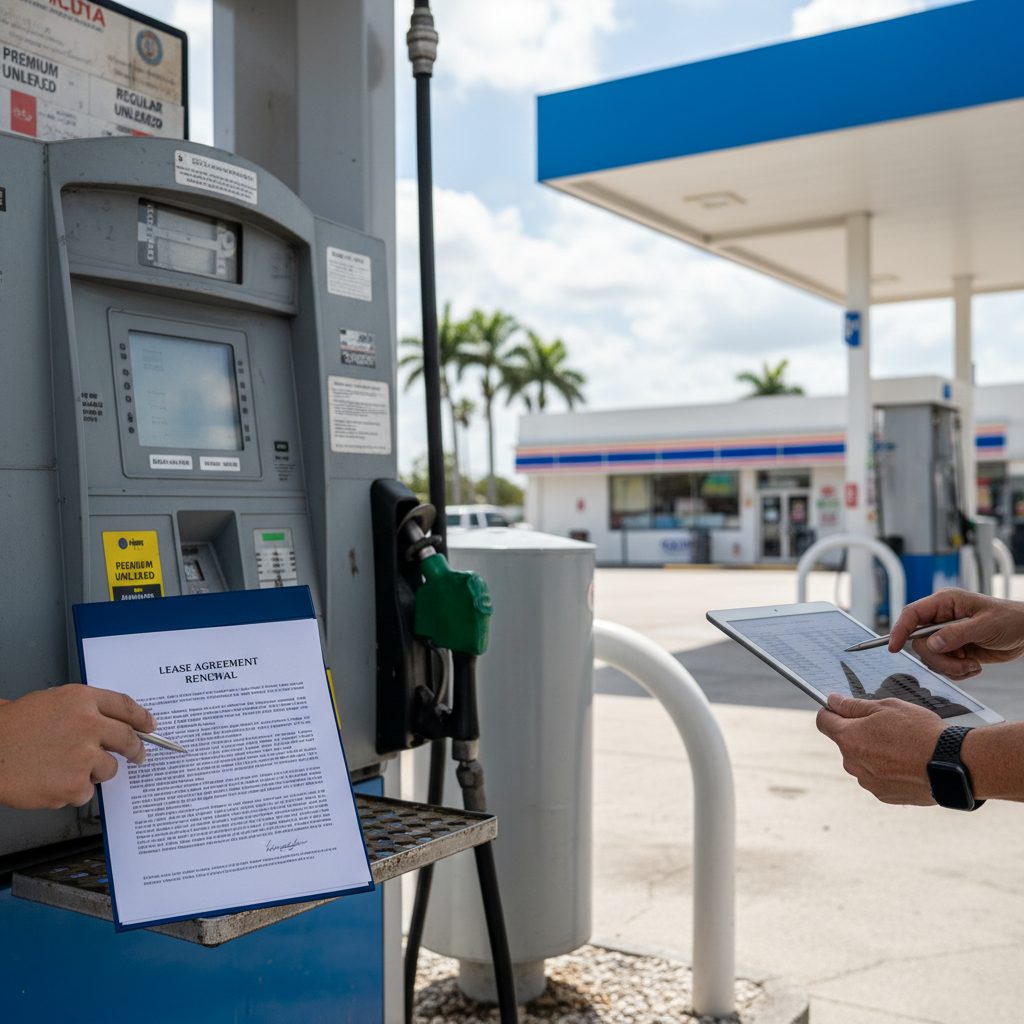
A dealer lease renewal is one of the highest-stakes negotiations a Florida gas station operator or investor will face, and it is almost always poorly prepared for. Lease renewal windows are typically defined in the agreement itself, and missing an option exercise deadline — even by a day — can result in loss of the renewal right entirely, leaving the operator negotiating from scratch at market terms with a landlord who knows the tenant's switching costs are enormous.
The Gas Station Group advises operators, investors, and landlords on dealer lease renewals across Florida — from branded supply agreement-linked leases on I-95 corridor sites to ground leases supporting independent operators in Orlando and Tampa. The principles of effective renewal negotiation are consistent: prepare early, understand market rent benchmarks, and never negotiate a lease renewal in isolation from the supply agreement it governs.
Market Rent Benchmarking and Option Exercise Timing
Before entering any dealer lease renewal negotiation, an operator must know where market rent actually sits for fuel retail real estate in the specific submarket. Florida's fuel retail rent market is highly geographically segmented: a high-AADT corner site on US-1 in Coral Gables commands fundamentally different economics than a comparable site on SR-50 in Clermont. Rent benchmarking requires access to actual closed lease comps — not asking rents — from comparable fuel retail locations, which only a specialist advisor with Florida fuel retail transaction history can reliably provide.
Option exercise timing is the single most dangerous procedural element of a dealer lease renewal. Most dealer leases require written notice of option exercise 180–365 days before the lease expiration — well before most operators begin thinking about renewal. Missing this window does not automatically terminate occupancy rights in Florida, but it typically converts the renewal from a contractual right to a negotiated extension, materially weakening the tenant's leverage. Florida gas station leasing and rental specialists track option exercise deadlines for clients as a standing service and initiate the renewal process at least 18 months before expiration.
Percentage-Rent Review and Fuel Volume Considerations
Many Florida dealer leases include a percentage-rent component tied to fuel gallonage, inside sales, or gross revenues — in addition to a base rent. As fuel volumes have normalized post-COVID and inside sales have grown through foodservice investment, percentage-rent provisions that were drafted to be rarely triggered are now activating regularly at well-performing sites. Operators entering renewal negotiations should audit their percentage-rent calculations for the prior 24–36 months and understand whether the landlord is capturing upside they did not intend to share.
In renewal negotiations, percentage-rent structures can be renegotiated alongside base rent. A landlord who has been capturing meaningful percentage rent may accept a higher fixed base rent in exchange for eliminating or raising the percentage-rent breakpoint — a structure that benefits operators with strong volume trends and investors who prefer predictable NNN cash flow. Conversely, operators in markets facing fuel volume pressure from EV adoption may negotiate lower base rent with a retained percentage-rent floor to protect the landlord's downside — a structure increasingly relevant on high-EV-penetration urban corridors in South Florida.
Image-Program Tie-In and Capital Contribution Leverage
Branded dealer leases are often synchronized with supply agreements that include image-program requirements — mandating periodic capital upgrades to dispensers, canopy, signage, or c-store interior. When a lease renewal coincides with a brand image-program cycle, the landlord and supplier are both potentially motivated to contribute capital, and the operator has leverage to negotiate rent relief in exchange for committing to the reimage investment. This triangular negotiation — operator, landlord, and supplier — is where specialist representation creates the most disproportionate value.
Operators who enter a lease renewal without surfacing the image-program tie-in often receive a lease extension at the same or higher rent while separately absorbing a $150,000–$300,000 reimage requirement with no landlord contribution. A coordinated negotiation that makes landlord rent concessions contingent on the operator's image program commitment can realistically generate $100,000–$500,000 of net present value in combined rent savings and capital contributions over a 10-year renewal term. This outcome is only achievable when the renewal negotiation explicitly connects the lease, supply agreement, and image program simultaneously.
Relocation Leverage and Alternative Site Pressure
One of the most underutilized forms of leverage in a dealer lease renewal is the credible alternative site threat. A landlord who believes the operator has no viable relocation option will negotiate accordingly. An operator who has identified a viable competing corner — even a site that is less ideal but genuinely buildable — negotiates from a completely different position. Florida's active commercial real estate market, particularly in high-growth corridors along I-75 in Sarasota and Manatee counties or along I-95 in St. Lucie and Indian River counties, often presents realistic relocation options that can be surfaced and held in reserve.
Beyond the relocation threat, operators should understand that a lease renewal is also an opportunity to address lease provisions that have become burdensome over time — exclusivity restrictions, prohibited use clauses, subletting limitations, and operating hour requirements. A lease renewal is one of the few moments when a landlord has a real incentive to accommodate tenant requests, and an experienced advisor who understands both the real estate and operational context of the Florida fuel retail leasing market will identify every point of negotiating leverage available.
Frequently Asked Questions
Speak With a Florida Gas Station Specialist
Request a confidential consultation or off-market opportunities and pricing through our contact page, or call +1-305-518-1545. The Gas Station Group is headquartered at 8603 S Dixie Hwy, Miami, FL 33143. Principal: Bobby Berrido.
Continue Reading