A single Florida gas station is an operating asset. A portfolio of five or more sites — geographically clustered, operationally integrated, and with a coherent brand and supply structure — is an institutional investment. The distinction is not merely semantic: it determines who buys the asset, what multiple they pay, what financing terms are available, and whether the exit is a retail transaction or an institutional capital markets event.
The Gas Station Group advises multi-site Florida fuel retail operators on portfolio aggregation strategy — from identifying the right mix of owned and leased sites to structuring the operational platform that institutional buyers require to transact at full premium. If your growth strategy involves acquiring five or more Florida gas stations, understanding the institutional math before you acquire site three is the most important planning exercise you will do.
Why Five-Plus Sites Unlock the Institutional Buyer Pool
Institutional buyers — private equity-backed c-store platforms, fuel retail REITs, and family offices with capital allocations above $20M — have minimum portfolio thresholds driven by their own economics: deal cost amortization, management overhead, and the minimum scale needed to optimize supply agreements, insurance programs, and operational systems. A single Florida gas station at $1.5M is a retail transaction. Five sites at $7.5M aggregate value begins to attract serious institutional attention. Ten sites at $15M+ with a coherent geographic cluster on a Florida interstate corridor will generate a competitive institutional process that can produce a 10–20% premium over the sum of five individual retail sales.
The valuation premium from institutional aggregation is driven by multiple expansion. A single-site independent Florida gas station typically trades at 4–6x adjusted EBITDA in a retail transaction. A five-plus site portfolio with demonstrated operational consistency, a manageable supply agreement structure, and geographic clustering on a high-growth Florida corridor — I-75 in Collier and Lee counties, I-95 in Brevard and Volusia, the Turnpike through Osceola and Polk — can realistically command 6.5–8.5x EBITDA from an institutional acquirer who sees platform value beyond the individual site economics.
Brand Mix Considerations and Supply Agreement Structure
Portfolio aggregation strategy in Florida fuel retail must address brand mix from the outset. A portfolio of five sites flying five different fuel flags — or a mix of branded and unbranded sites — is operationally manageable but requires managing five separate supply agreements, five image-program cycles, and five sets of brand standards. Institutional buyers who acquire fuel retail portfolios strongly prefer simplified brand structures: a single branded flag across all sites under one jobber relationship, or a clean unbranded open-dealer platform that allows a single consolidated supply agreement with a major terminal operator.
The supply agreement rationalization that precedes a portfolio sale is often the most value-accretive pre-sale preparation step available. Consolidating four different branded agreements into a single unbranded or single-brand jobber relationship — even if it requires paying out image loan balances on underperforming brand flags — can expand the buyer pool, reduce institutional due diligence complexity, and directly increase the multiple paid at exit. Fuel supply agreement advisory is a critical tool in portfolio pre-sale preparation and should be engaged 18–24 months before a planned portfolio exit.
Geographic Clustering and Operational Synergy
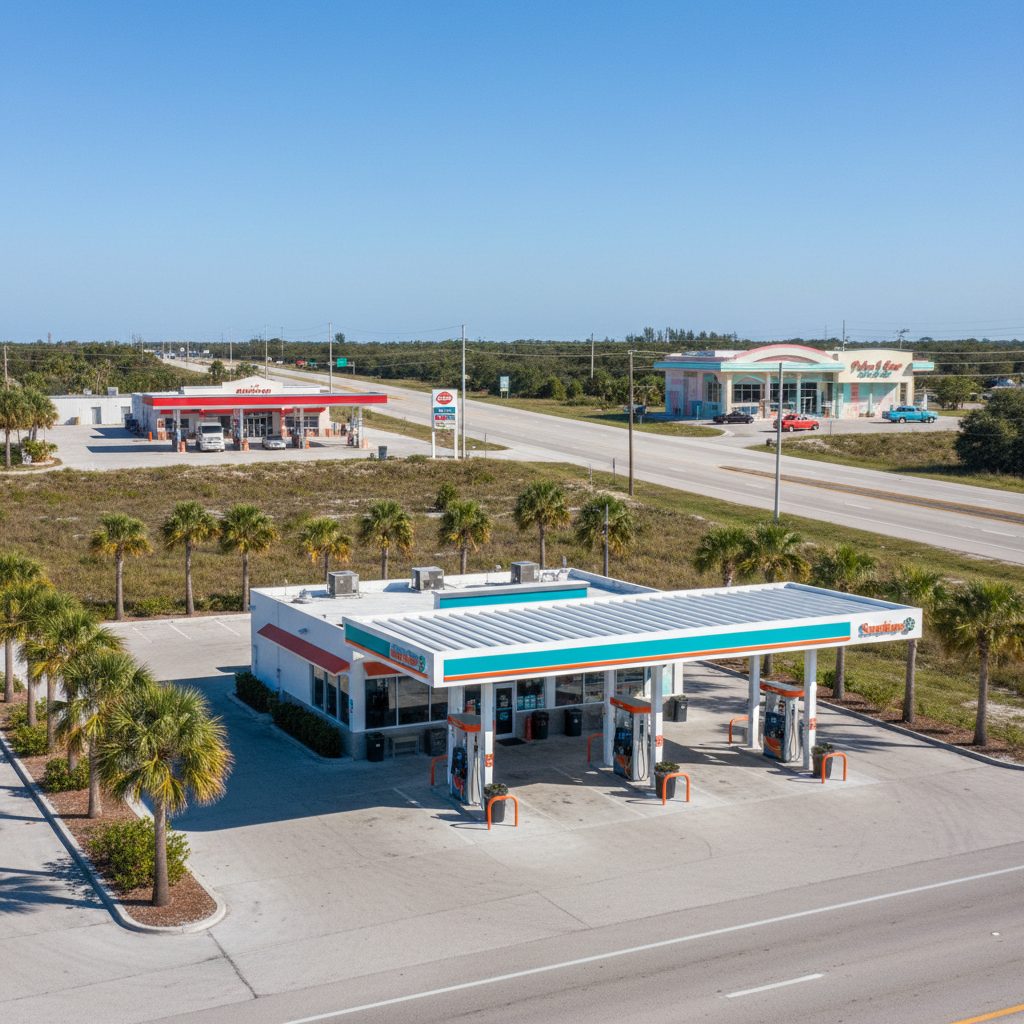
Geographic clustering is the single most important structural principle in Florida fuel retail portfolio aggregation. A cluster of five sites within a 30-mile radius — say, the Sarasota/Bradenton market between I-75 and US-41 — can be managed by a single operations team, served by a single fuel transport route, supervised by a single area manager, and positioned as a market-dominant platform to a prospective buyer seeking immediate market share in a high-growth Florida MSA. A scattered portfolio of five sites in five different Florida markets offers none of these operational synergies.
The operational synergy of a clustered Florida portfolio is not just a management efficiency — it is a valuation input. Institutional buyers model central overhead costs as a percentage of revenue, and a geographically clustered portfolio has demonstrably lower overhead per site than a dispersed collection. Fuel transport cost savings alone — a single tanker truck route serving five clustered sites versus five separate delivery routes — can represent $40,000–$80,000 in annual operating savings that flow directly to EBITDA and therefore directly to portfolio valuation. Operators building Florida portfolios with a sale in mind should resist the temptation of an opportunistically priced site in a non-contiguous market at the expense of cluster discipline.
Lease-Up of Operator-Occupied Sites and Sale-Leaseback Premium Math
Many multi-site Florida operators own the real estate at some of their sites and lease at others. The institutional portfolio sale process is significantly simplified — and the aggregate value maximized — when all real estate is either owned or leased under a consistent NNN structure that an institutional buyer can underwrite on a single basis. Operator-occupied owned sites that carry no formal lease must be converted to a market-rate NNN lease before or concurrent with the portfolio sale — a process that simultaneously monetizes the real estate equity and creates the lease structure institutional buyers require.
The premium math on a lease-up sale-leaseback within a portfolio aggregation is powerful. A five-site Florida portfolio where two sites are operator-owned without formal leases may trade at 5.5x EBITDA as-is, with a buyer applying a discount for the lease-up complexity. The same portfolio, with all five sites on 15-year NNN leases and two simultaneous sale-leaseback transactions closed prior to portfolio marketing, may trade at 7.0x EBITDA from an institutional buyer who sees a clean, fully structured investment. That 1.5x multiple expansion on a $750,000 annual EBITDA portfolio is $1.125M of incremental value — created entirely by transaction structuring. Florida gas station investment sales specialists who understand both the operating business and the real estate simultaneously are the right advisors to execute this strategy.
Frequently Asked Questions
Speak With a Florida Gas Station Specialist
Request a confidential consultation or off-market opportunities and pricing through our contact page, or call +1-305-518-1545. The Gas Station Group is headquartered at 8603 S Dixie Hwy, Miami, FL 33143. Principal: Bobby Berrido.
Continue Reading