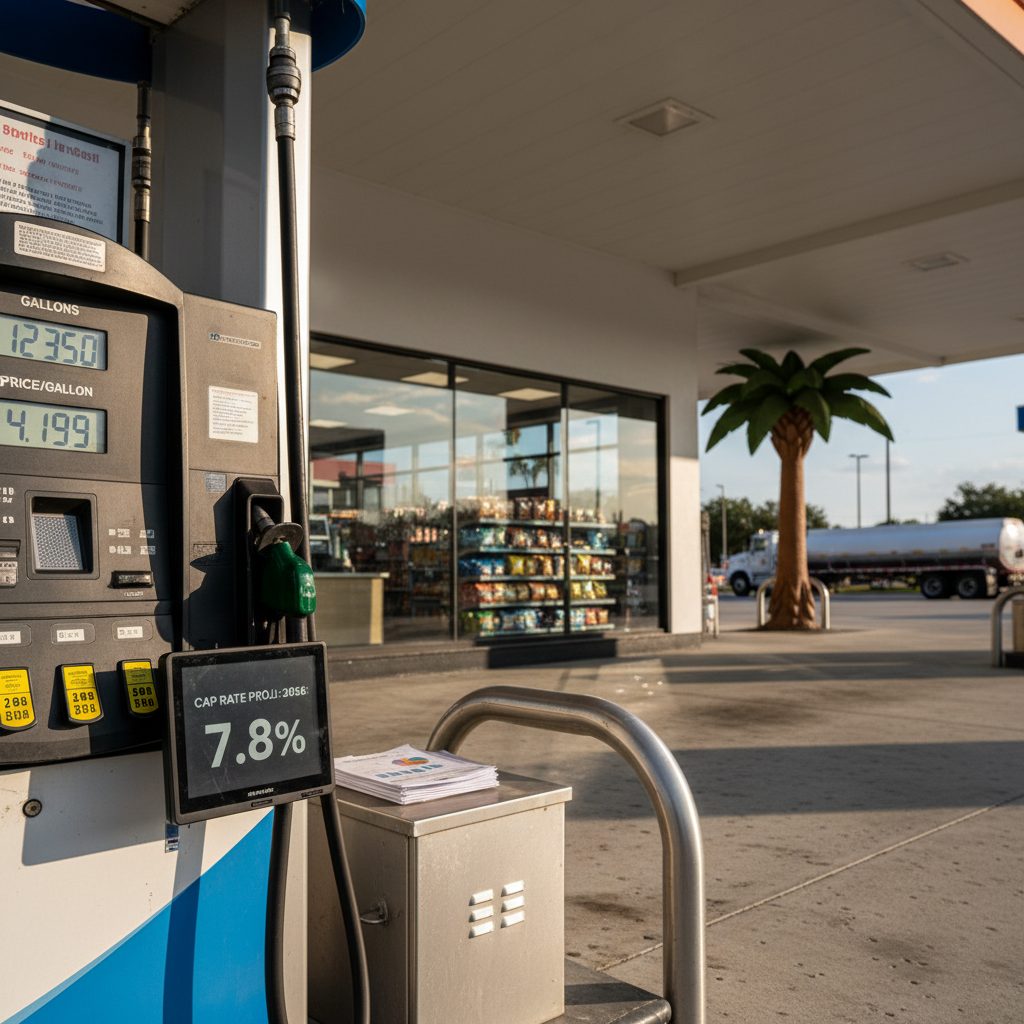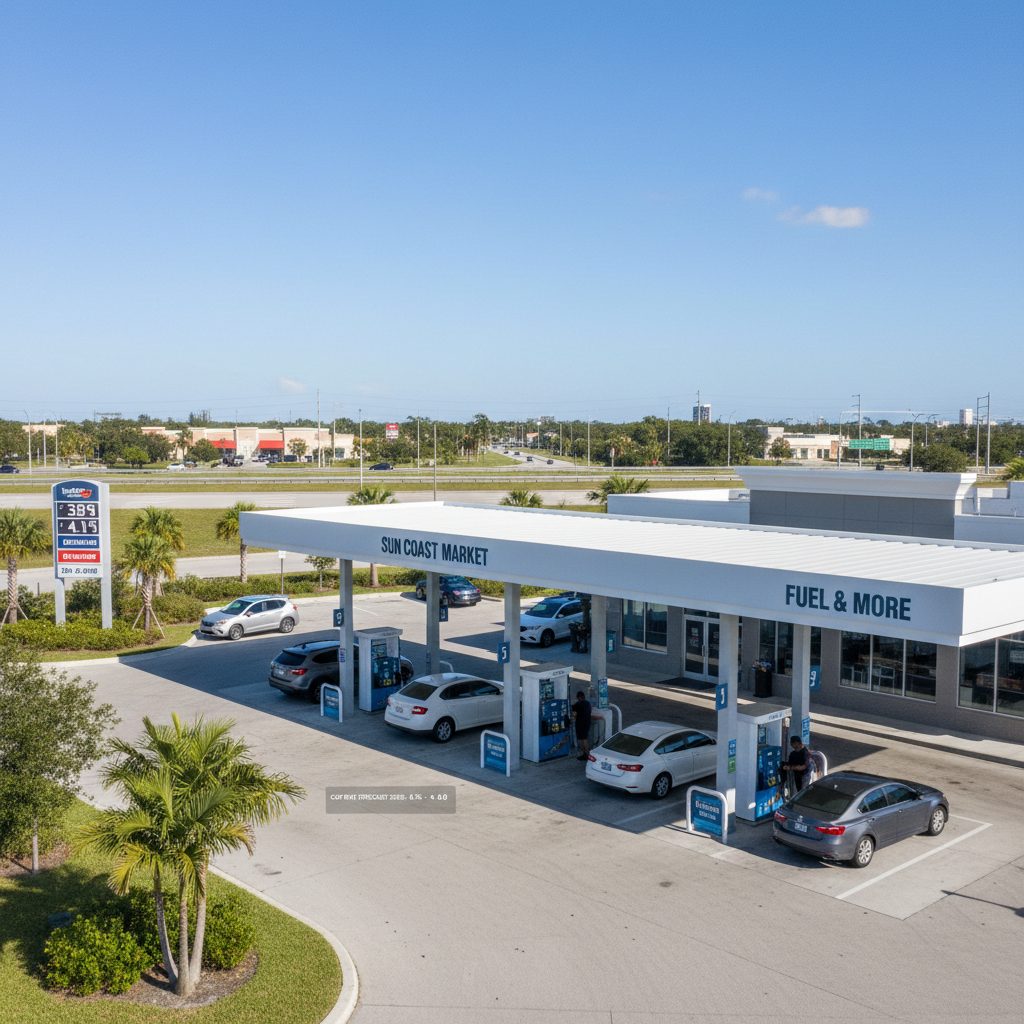
Florida gas station investment entered 2026 with cap rates under sustained compression at the branded, credit-tenanted end of the spectrum while operator-leased and unbranded assets held a meaningful premium — reflecting the market's continued bifurcation between lease-quality and operational risk. Buyers pricing deals today must reconcile rising cost of capital with constrained supply across the I-95 and Florida's Turnpike corridors, where high-AADT locations rarely surface on the open market.
Understanding where cap rates actually clear — by brand, lease structure, and credit quality — is the starting point for every acquisition underwrite. Gas station investment sales in Florida require a Florida-specific lens: the state's population growth, tourism traffic, and port-linked freight demand create demand dynamics that diverge sharply from national averages.
Where Cap Rates Sit by Brand, Lease, and Credit
Branded NNN assets anchored by investment-grade oil majors — Shell, BP, Chevron, ExxonMobil — traded in the 4.75–5.50% cap range entering 2026, depending on lease term remaining, corporate versus franchisee guarantee, and rent escalation structure. Assets with 15-plus years of remaining term and CPI-linked bumps commanded the tightest pricing, particularly along Florida's Turnpike and I-75 where truck and tourism traffic reinforce rent coverage.
Operator-leased stations — where a regional dealer or independent jobber is the credit — typically clear 150 to 250 basis points wider, landing in the 6.25–7.50% range for well-located assets with demonstrable fuel volume above 100,000 gallons per month. The spread compensates for single-operator credit risk and the structural complexity of leases that include environmental indemnification carve-outs, equipment ownership clauses, and fuel-brand conversion provisions that institutional buyers scrutinize closely.
What's Driving 2026 Cap Rate Movement
Three forces shaped 2026 cap rate movement: elevated Treasury yields anchoring investor return hurdles, a constrained development pipeline due to FDEP permitting timelines and environmental carrying costs, and continued population in-migration into South Florida, the I-4 corridor, and the Jacksonville metro. Together, these dynamics have kept cap rates from expanding materially despite the higher rate environment — supply scarcity is absorbing cost-of-capital pressure that would otherwise push rates wider.
1031 exchange demand has been a consistent floor under pricing. Florida's lack of a state income tax draws out-of-state exchangors rotating out of California, New York, and Illinois apartments into NNN fuel retail, compressing yields on institutional-quality product. Meanwhile, private-equity platforms aggregating fuel-retail REITs have maintained institutional bid discipline on portfolio-level acquisitions, further anchoring the top of the market.
Branded NNN Compression and the Operator-Leased Premium
Branded NNN compression is most acute where remaining lease term is long, the brand is a top-tier major, and fuel volume is verifiable above 150,000 gallons monthly. In these scenarios, buyers have accepted sub-5.00% going-in yields, underwriting residual land value and brand optionality as yield support. Fort Lauderdale, Miami-Dade, and the Tampa Bay MSA produced the most aggressive pricing in this tier through late 2025 and into 2026.
The operator-leased premium exists because these assets require active asset management: lease renewals, fuel-supply contract oversight, and environmental liability monitoring that NNN structures eliminate. For private buyers with fuel-retail operating experience, this premium represents genuine alpha. For institutional buyers without a fuel-operating platform, the additional 150–250 bps of yield compensates for complexity rather than offering a pure return pickup.
Interest-Rate Pass-Through and Buyer Strategy
Unlike multifamily or office, fuel retail cap rates have not repriced one-for-one with the 10-year Treasury. The structural undersupply of quality Florida locations has absorbed roughly 60–70% of rate-driven repricing pressure, meaning buyers relying on 2021-era leverage assumptions are underwriting into negative leverage on branded NNN assets without preferred equity or seller financing to bridge the gap. Debt coverage discipline — targeting 1.20x DSCR at realistic in-place NOI — remains the underwriting anchor.
Buyers active in 2026 are pursuing three strategies: acquiring operator-leased assets with value-add lease restructuring potential, bidding on off-market portfolios where bulk pricing offsets individual-asset tightness, and targeting sale-leaseback structures with operating groups seeking liquidity. Each strategy requires deep Florida market knowledge and a network that surfaces opportunities before they reach the broader market. Off-market gas stations in Florida represent the most consistent source of yield-positive acquisitions in the current environment.
Frequently Asked Questions
Speak With a Florida Gas Station Specialist
Request a confidential consultation or off-market opportunities and pricing through our contact page, or call +1-305-518-1545. The Gas Station Group is headquartered at 8603 S Dixie Hwy, Miami, FL 33143. Principal: Bobby Berrido.
Continue Reading