When a Florida gas station's land value substantially exceeds its operating value — a condition increasingly common in urban infill markets across Miami-Dade, Broward, and Tampa — the highest and best use of the site shifts from fuel retail to redevelopment. Identifying this inflection point, navigating FDEP closure requirements, and selecting the right alternative use is a distinct skill set from gas station brokering, but one that The Gas Station Group brings to every site analysis in Florida's densifying corridors.
Pad redevelopment is not a last resort for underperforming sites — it is a legitimate exit strategy for owners holding contaminated or structurally obsolete fuel-retail properties where automotive and fuel-adjacent property markets in Florida have shifted toward higher-density, higher-return uses that the existing improvements no longer support.
When Redevelopment Value Exceeds Operating Value
The redevelopment inflection point occurs when the land value — estimated via comparable sales of cleared commercial pads in the same submarket — exceeds the capitalized operating income of the fuel-retail business by a sufficient margin to justify the cost of environmental closure, demolition, and entitlement. In Miami's Little Havana, Brickell adjacencies, and coastal Broward communities, this threshold has been crossed for most sites below 20,000 gallons per month in fuel volume. In suburban Tampa and Jacksonville, the inflection typically requires higher land values driven by QSR or car-wash operator demand.
A practical test: if the land, cleared and remediated, would trade at or above 1.5x the capitalized value of the operating business, redevelopment economics warrant serious analysis. Owners often anchor to operating income as a floor value without modeling the redevelopment ceiling — a common valuation error that leaves significant equity unrealized. Engaging a Florida fuel-retail broker with redevelopment transaction experience is the starting point for an honest highest-and-best-use analysis.
FDEP Closure Prerequisites
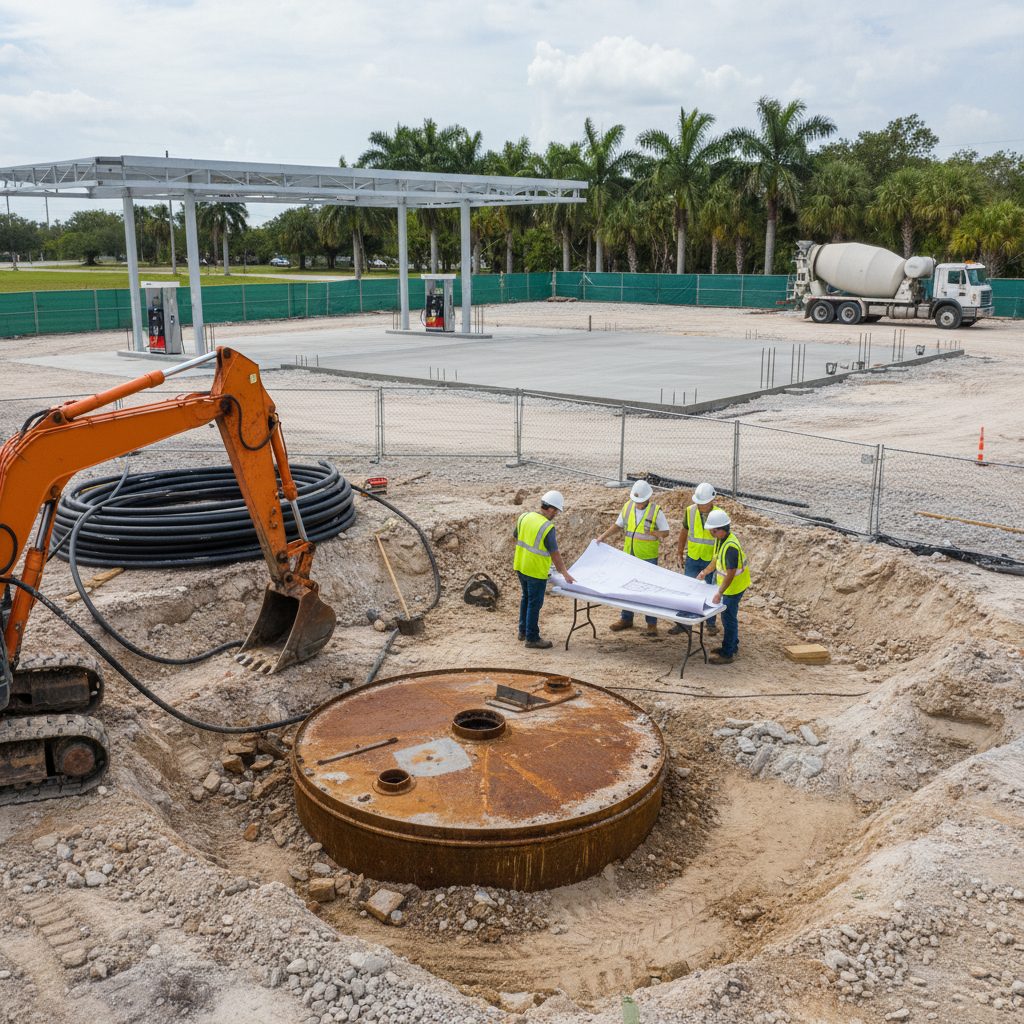
Before a Florida gas station pad can be redeveloped, the site must complete Florida Department of Environmental Protection (FDEP) underground storage tank closure, which includes tank removal by a licensed contractor, soil sampling at tank excavation perimeter and dispenser islands, and submission of a site closure report to the FDEP district office. If contamination is detected above applicable cleanup target levels, the site enters the FDEP remediation program and an open discharge case is assigned — which does not prevent redevelopment but does require an active remediation program to be maintained during and after construction.
FDEP closure timelines vary by district and contamination complexity. Clean closures — no detected contamination above thresholds — can receive a No Further Action (NFA) letter within 60–120 days of closure report submission. Sites with open discharge cases may operate in FDEP's IPTF (Inland Protection Trust Fund) program, which provides partial state funding for remediation and allows redevelopment to proceed with an approved remediation plan in place. Coordinating FDEP closure timing with the redevelopment entitlement timeline is critical to minimizing carrying-cost exposure.
Common Redevelopment Uses: QSR, Express Wash, Quick Lube
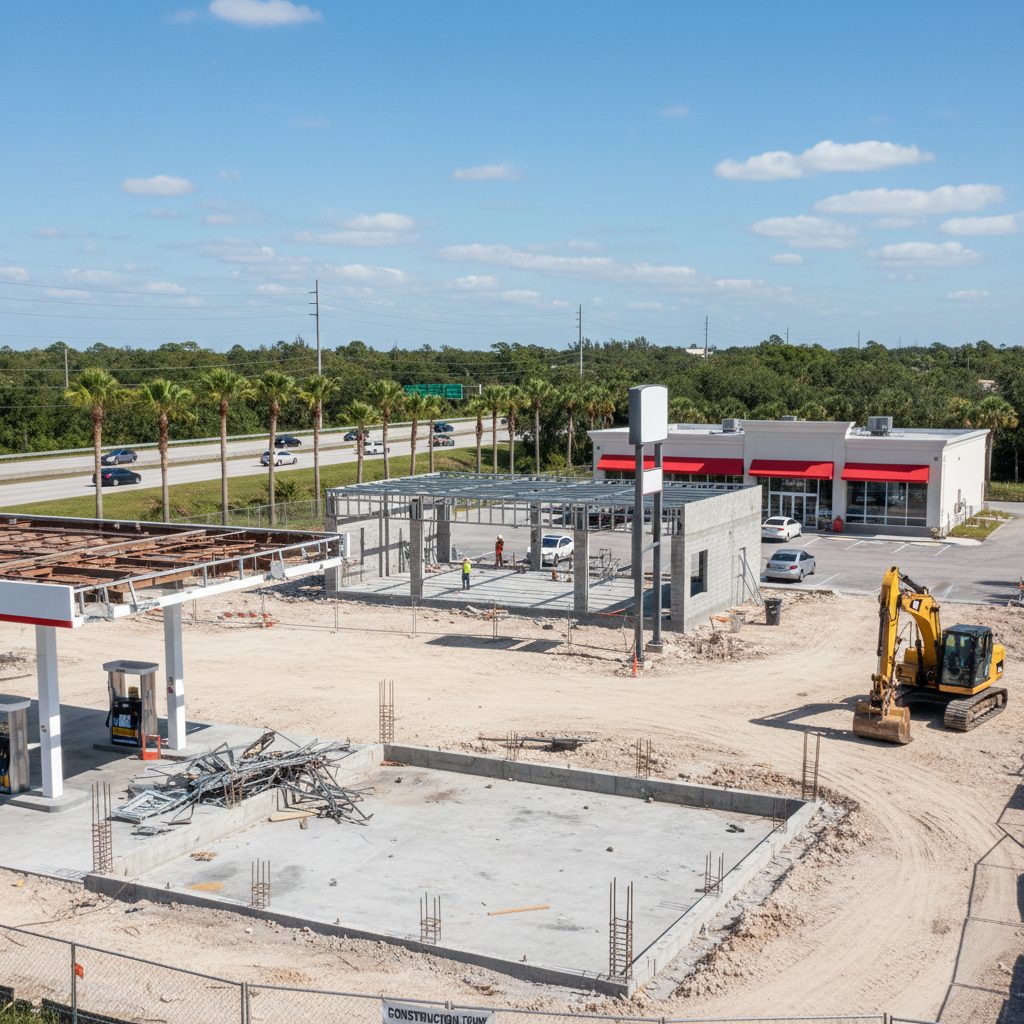
Three redevelopment uses dominate Florida gas station pad conversions in 2025–2026: quick-service restaurants (QSR), express car washes, and quick-lube facilities. QSR operators — particularly drive-through-only formats from national chains — have been aggressive Florida acquirers of cleared fuel-retail pads because the existing curb cuts, canopy foundations, and commercial zoning often align with drive-through site plan requirements. National QSR brands can pay $1.5–$3.5 million for cleared and remediated pads in high-traffic Florida corridors, creating a strong exit market for owners.
Express car wash operators have been equally aggressive, with consolidators and regional chains competing for sites along Florida's Turnpike service corridors, suburban I-95 exits, and Orlando's ring-road suburbs. A 30,000-40,000 square foot cleared gas station pad can accommodate the tunnel, vacuum stations, and stacking lane required for a full express wash format. Quick-lube conversions are the most modest redevelopment use but require the least entitlement complexity, as automotive service is typically a permitted use in commercial zoning categories already applicable to most Florida gas station sites.
Entitlement Steps and Execution Timeline
Florida gas station redevelopment entitlement follows a sequential process: zoning confirmation or rezoning (if the proposed use requires a different designation), site plan approval from the local planning department, building permit issuance, and certificate of occupancy. Most Florida municipalities apply C-2 or C-3 commercial zoning to fuel-retail sites, which accommodates QSR, automotive, and car-wash uses as of-right or with minor special exception approval — materially faster than rezoning timelines in other states.
A realistic execution timeline from FDEP tank closure to certificate of occupancy on a Florida pad redevelopment project runs 18–30 months, depending on remediation status, municipality permitting pace, and site plan complexity. Owners considering redevelopment should begin FDEP closure and entitlement planning simultaneously rather than sequentially — parallel-tracking these processes can compress the total timeline by six months or more. Automotive property advisory in Florida through The Gas Station Group includes redevelopment feasibility analysis for owners evaluating this exit strategy.
Frequently Asked Questions
Speak With a Florida Gas Station Specialist
Request a confidential consultation or off-market opportunities and pricing through our contact page, or call +1-305-518-1545. The Gas Station Group is headquartered at 8603 S Dixie Hwy, Miami, FL 33143. Principal: Bobby Berrido.
Continue Reading