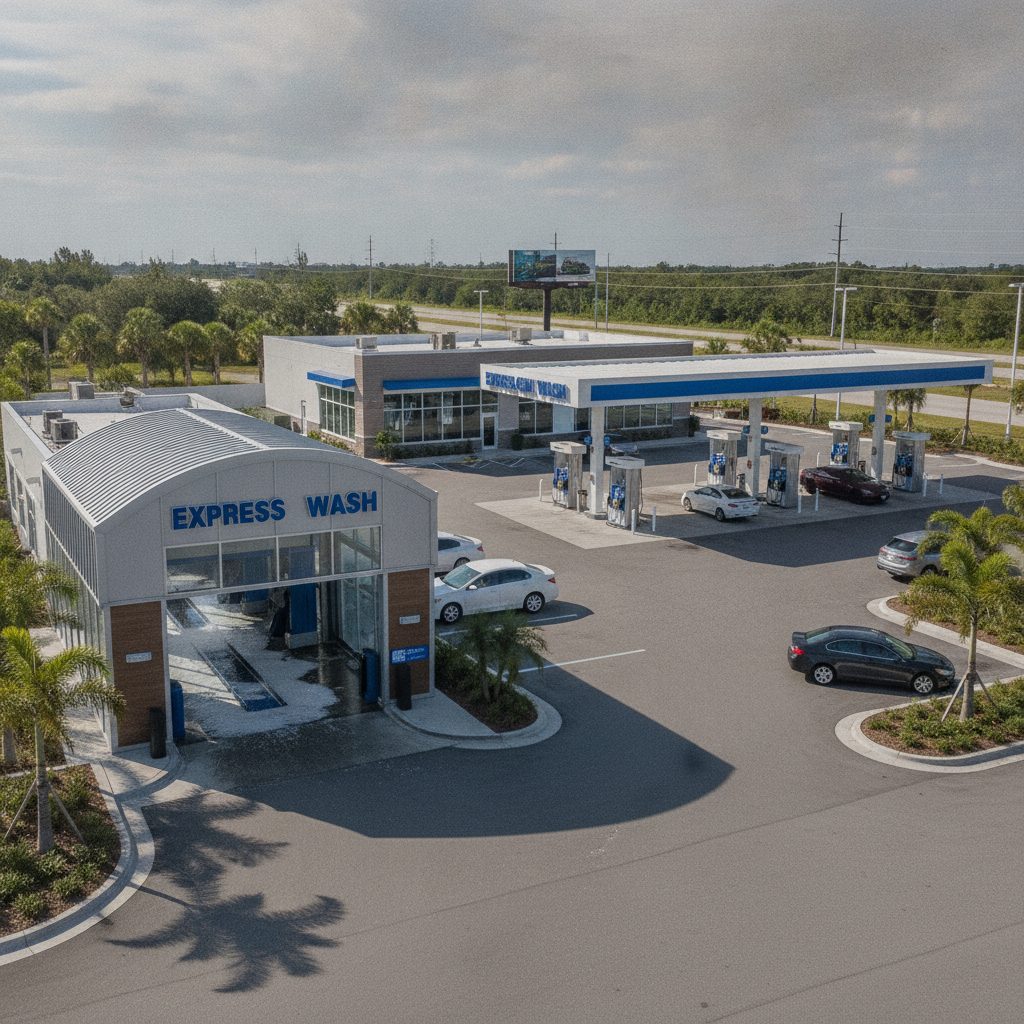
The express car wash has become one of Florida's most sought-after single-tenant net-lease investment categories, driven by membership-model economics that generate predictable monthly recurring revenue, high throughput relative to land consumption, and an institutional exit market dominated by well-capitalized consolidators actively acquiring Florida wash portfolios. For investors evaluating the broader automotive property investment landscape in Florida, express washes represent the highest-multiple exit opportunity among fuel-adjacent asset types.
Understanding the economics — from membership unit counts and throughput capacity to capital expenditure, water reclaim requirements, and cap-rate benchmarks — is essential for any Florida investor evaluating express car wash development, acquisition, or sale.
Membership Economics: The Unlimited Wash Club Model
The unlimited monthly car wash membership — branded variously as UWC, UMC, or Wash Club depending on the operator — is the economic engine of the Florida express wash model. Members pay $20–$35 per month for unlimited wash access, creating monthly recurring revenue that is independent of weather, discretionary spending cycles, and single-visit pricing competition. A Florida express wash with 2,000 active members generating an average of $28 per month produces $56,000 in monthly recurring revenue before a single retail or fleet wash transaction.
Membership penetration benchmarks for mature Florida express wash operations run 60–75% of total wash revenue from memberships, with the remainder from retail single-wash and fleet transactions. Sites with strong membership penetration trade at premium multiples to sites that are retail-dominant, because membership revenue is recurring, predictable, and dramatically more lender-friendly than transactional income. New Florida express wash developments targeting 2,000-plus members within 12 months of opening are underwriting to achievable benchmarks in high-density suburban markets along the I-4 corridor and South Florida.
Throughput, Capex, and Water Reclaim
Express car wash throughput — vehicles processed per hour — is the primary operating leverage point. A 150-foot tunnel operating at full efficiency can process 100–130 vehicles per hour, and Florida's year-round driving season means that peak utilization windows (7 AM–9 AM and 4 PM–7 PM) are consistently achievable 12 months per year without the seasonal throughput collapses experienced in northern markets. Sites on high-AADT Florida corridors with 50,000-plus daily vehicles can sustain peak throughput during demand windows that justify premium development costs.
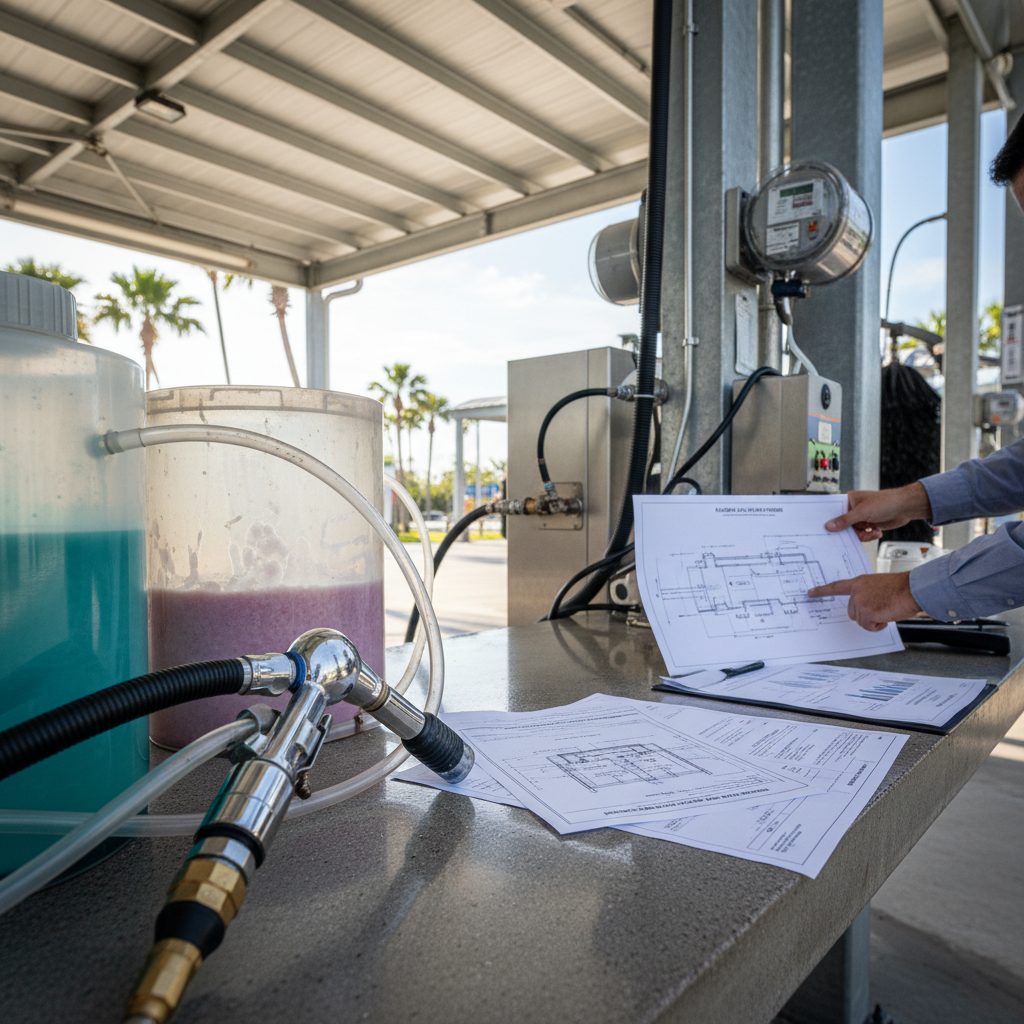
Total development cost for a new-build Florida express wash — including land, tunnel, vacuum stations, equipment, stacking lanes, and site work — runs $4.5–$7.5 million depending on tunnel length, equipment specification, and land cost. Water reclaim systems are not merely an environmental preference in Florida — they are often required by local utilities managing aquifer draw-down in a water-stressed state, and their absence limits permitting and operational approval in many Florida jurisdictions. High-efficiency reclaim systems recovering 80-plus percent of process water are the market standard for new Florida express wash development.
Cap Rate Range and Institutional Exit Market
Stabilized Florida express car wash assets with strong membership counts, NNN lease structures, and qualified operator-tenants have traded in the 5.00–6.25% cap range, with the tightest pricing on corporate-guaranteed leases from national or super-regional operators. Owner-operated washes without a leaseback structure trade at higher cap rates — typically 6.50–8.00% on an EBITDA multiple basis — reflecting operator concentration risk and the additional complexity of business-value underwriting versus pure lease underwriting.
The institutional exit market for Florida express washes is well-developed and highly competitive. National consolidators — Mister Car Wash, Magnolia Car Wash, Splash, and regional Florida platforms — have been active acquirers of both single sites and multi-site portfolios throughout 2024–2026. These platforms underwrite on EBITDA multiples ranging from 8x–14x for strong Florida sites, translating to asset values that significantly exceed replacement cost on stabilized, membership-heavy operations. Florida's lack of state income tax and favorable operating environment make it a priority consolidation market for all major national wash platforms.
Site Selection and Florida-Specific Development Considerations
Successful Florida express wash site selection focuses on three criteria: AADT counts above 40,000 vehicles daily on the primary road, high household density within a one-mile radius (minimum 8,000–12,000 households), and site geometry that accommodates tunnel orientation, stacking lane, and vacuum island without requiring variances that add entitlement risk. Florida's flat topography eliminates grade change as a site constraint, but impervious surface ratios in environmentally sensitive areas — particularly near Everglades protection zones in Miami-Dade and Broward — can limit site coverage and require compensatory retention.
Municipalities along the I-4 corridor, Tampa Bay ring roads, and South Florida suburban communities have become increasingly familiar with express wash entitlement, reducing approval timelines for well-prepared site plans. Florida DOT access management rules — governing curb cut placement and turn-lane requirements — are the most common site-level obstacle for high-AADT frontage sites and should be evaluated with a Florida traffic engineer before executing a site purchase agreement. Explore Florida automotive property investment opportunities including express car wash sites and existing operations through The Gas Station Group.
Frequently Asked Questions
Speak With a Florida Gas Station Specialist
Request a confidential consultation or off-market opportunities and pricing through our contact page, or call +1-305-518-1545. The Gas Station Group is headquartered at 8603 S Dixie Hwy, Miami, FL 33143. Principal: Bobby Berrido.
Continue Reading