Quick-lube facilities have established themselves as a durable Florida automotive-investment category, combining recurring consumer demand, low per-visit labor intensity, and real-estate characteristics — high-AADT frontage, drive-through configuration, modest footprint — that translate into a distinct investment profile from general automotive service. For investors evaluating the full automotive property investment spectrum in Florida, quick-lube represents the lowest technology risk in the portfolio alongside the strongest EV-resilience argument among traditional automotive service categories.
Whether you are evaluating a franchise quick-lube acquisition, an independent bay-count operation, or the NNN real-estate component of an existing Florida quick-lube asset, understanding the economics — from bay count throughput to cap-rate benchmarks and demographic targeting — determines whether the investment underwrites at your required return.
Franchise Versus Independent Quick-Lube Operations
Florida's quick-lube market is divided between franchise networks — Jiffy Lube, Valvoline Instant Oil Change, Grease Monkey, Take 5 — and independent operations, each with distinct investment profiles. Franchise operators benefit from national brand recognition that drives trial visits from Florida's tourist and transient population, corporate-mandated operational standards that support consistent service delivery, and proprietary point-of-sale systems that generate the financial data transparency institutional buyers require. The trade-off is franchise royalties — typically 5–8% of gross revenue — that reduce operating margins versus comparable independent operations.
Independent quick-lubes in Florida trade on local brand equity and operator efficiency. They carry higher margin potential — absence of royalty drag and greater flexibility in parts sourcing — but are priced at lower EBITDA multiples than franchise counterparts due to limited brand transferability and the risk of customer attrition when a well-known owner-operator exits. For buyers with strong operational backgrounds and local market knowledge, independent Florida quick-lubes offer acquisition multiples 1.5x–3.0x lower than comparable franchise assets with similar bay counts and EBITDA — a meaningful entry-point advantage.
Bay Count Economics and Throughput
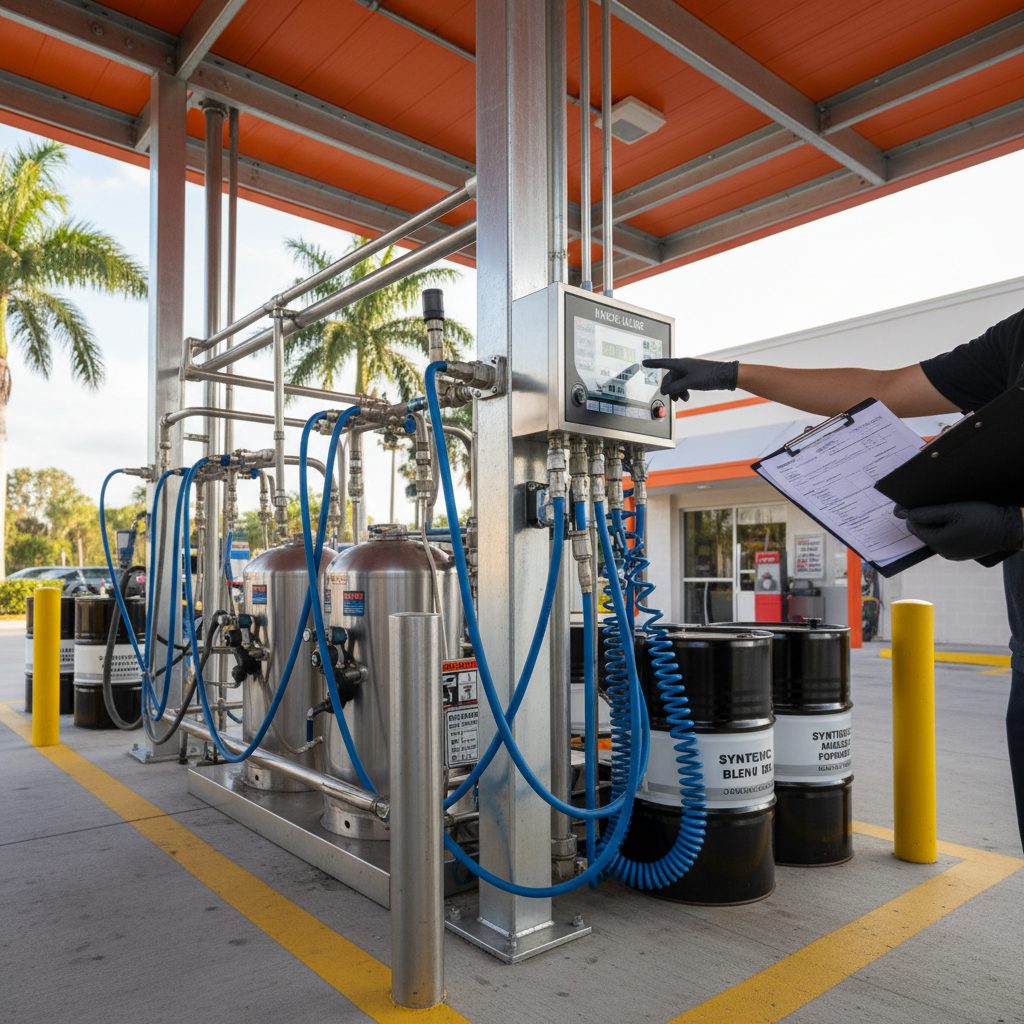
Bay count is the primary operational leverage variable in quick-lube economics. Florida drive-through quick-lube formats — single or dual pit-bay configurations without mechanical hoists — optimize throughput by eliminating vehicle lift time and enabling simultaneous multi-point service. A single-bay drive-through Florida quick-lube can complete 12–18 oil changes per hour at full efficiency; a three-bay format scales proportionally, with labor efficiency improving because administrative and customer-service tasks are shared across higher volume.
Revenue per vehicle in Florida quick-lube operations averages $65–$95 for a standard oil change plus ancillary services — air filters, cabin filters, wiper blades, fluid top-offs — with upsell attachment rates of 40–65% at well-managed locations. At 60 vehicles per day across a three-bay Florida quick-lube generating $80 average ticket, daily revenue runs $4,800 — approximately $1.75 million annually. Florida operators who achieve 70-plus vehicles per day per operating unit through marketing discipline and service speed are generating unit economics that support strong valuations at acquisition.
Real Estate Cap Rates and NNN Investor Appeal
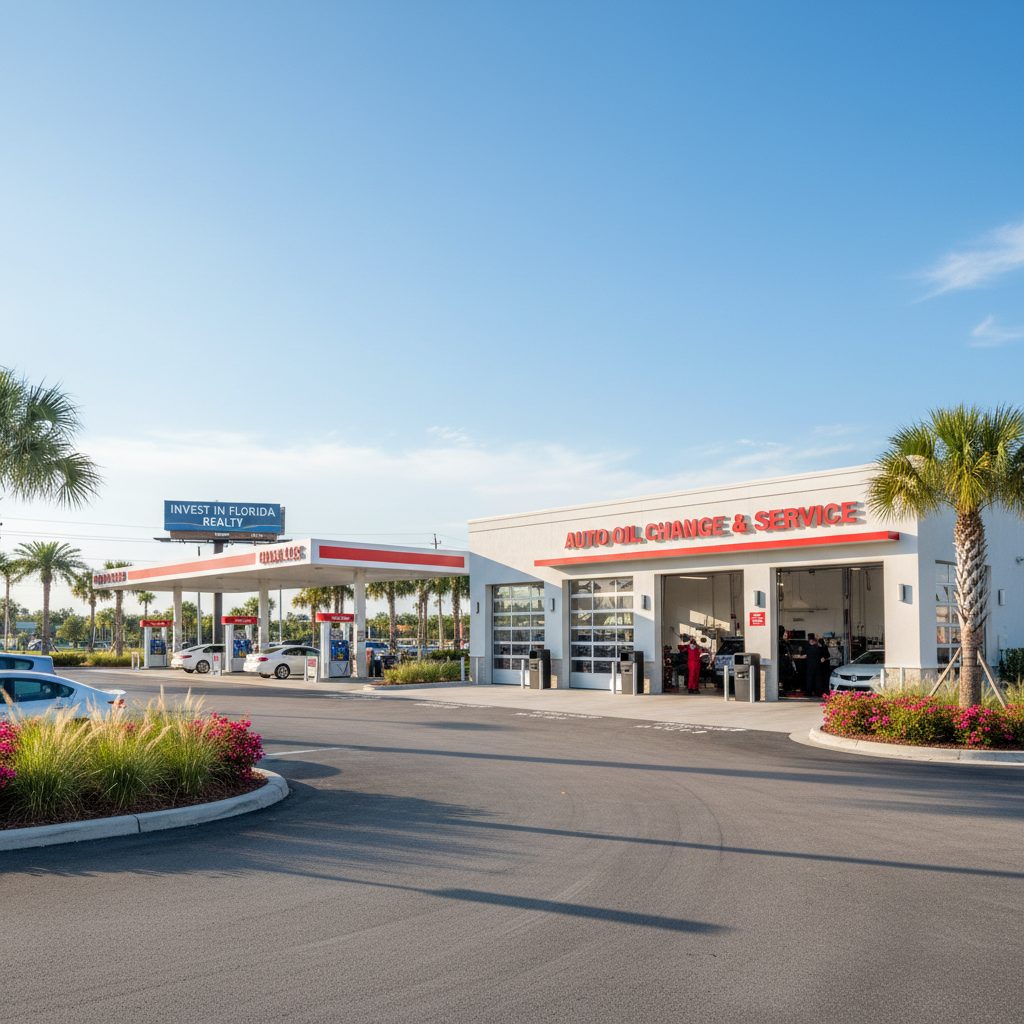
Quick-lube real estate — particularly single-tenant NNN-leased assets with national franchise tenants on 15-plus year leases — has attracted increasing institutional investor interest in Florida, trading in the 5.25–6.50% cap range for strong credits including Valvoline and Take 5 with corporate-guaranteed leases. The asset's small footprint (typically 3,000–5,000 square feet on 0.5–1.0 acres), high-AADT frontage requirement, and drive-through configuration create a real-estate profile that resembles fast-food NNN assets — a familiar investment category for Florida's active 1031 exchange buyer pool.
Sale-leaseback transactions have been a significant source of Florida quick-lube real estate investment opportunities, as franchise operators and private-equity-backed roll-up platforms monetize owned real estate to fund continued unit growth. These transactions — where the operator sells the land and building and simultaneously signs a long-term NNN lease — produce the institutional-grade lease structures that net-lease REITs and 1031 exchange capital target. Florida's active quick-lube consolidation by platforms like Heartland Automotive Services and Jiffy Lube's franchise ecosystem continues to generate sale-leaseback supply in the state's primary MSAs.
Demographics That Work and the EV-Resilience Argument
The strongest Florida quick-lube demographic profile combines: households with one or more internal combustion engine vehicles, median household income of $45,000–$85,000 (the value-seeking consumer who maintains their vehicle but outsources oil changes), and daily commute patterns that generate regular vehicle-mileage accumulation. Florida's I-95 corridor suburbs — Boca Raton, Pembroke Pines, and the South Jacksonville metro — and the I-4 Orlando suburb ring consistently produce this demographic profile and host multiple profitable quick-lube operations at 2–3 mile spacing.
The EV-resilience argument for quick-lube investment is grounded in vehicle fleet reality: Florida's internal combustion engine vehicle count will remain above 90% of total registered vehicles through at least 2035 under any credible EV adoption scenario, based on current Florida DMV registration trends and national EV penetration forecasts. Quick-lubes that add multi-point inspections, cabin air filter service for EVs, tire rotations, and brake fluid checks — all applicable to electric vehicles — can partially offset any long-term ICE service volume reduction. For investors with a 10–15 year hold horizon, Florida quick-lube real estate presents a more resilient automotive-service thesis than any repair category dependent on ICE-specific mechanical failure. Contact The Gas Station Group to discuss Florida automotive property acquisitions including quick-lube opportunities.
Frequently Asked Questions
Speak With a Florida Gas Station Specialist
Request a confidential consultation or off-market opportunities and pricing through our contact page, or call +1-305-518-1545. The Gas Station Group is headquartered at 8603 S Dixie Hwy, Miami, FL 33143. Principal: Bobby Berrido.
Continue Reading