Location is the single most durable driver of a Florida gas station's long-term value. A well-located site on a high-AADT corridor with strong ingress/egress can survive mediocre management, a weak supply agreement, and a tired canopy. A poorly located site — even one with excellent operations and a competitive fuel price — will underperform permanently. There is no operational fix for bad real estate.
The Gas Station Group evaluates site selection criteria across every major Florida corridor — from the I-95 spine through Miami, Fort Lauderdale, and Jacksonville, to the I-75 gateway markets of Naples and Tampa, to the I-10 and US-90 Panhandle routes. The principles that drive site value in Florida fuel retail are specific, measurable, and knowable before you commit capital.
AADT, Side-of-Road, and Signal Placement
Annual Average Daily Traffic (AADT) is the baseline metric for any Florida fuel retail site analysis. FDOT publishes AADT counts for every numbered roadway segment in the state, and most high-performing Florida gas stations sit on corridors with 25,000–80,000+ AADT. However, raw traffic count alone is insufficient — the direction of that traffic relative to the site, the commute pattern, and the time-of-day distribution matter equally. A site on the outbound side of a major arterial in a bedroom community will capture morning commute traffic; a site on the inbound side may be largely invisible to the same commuters.
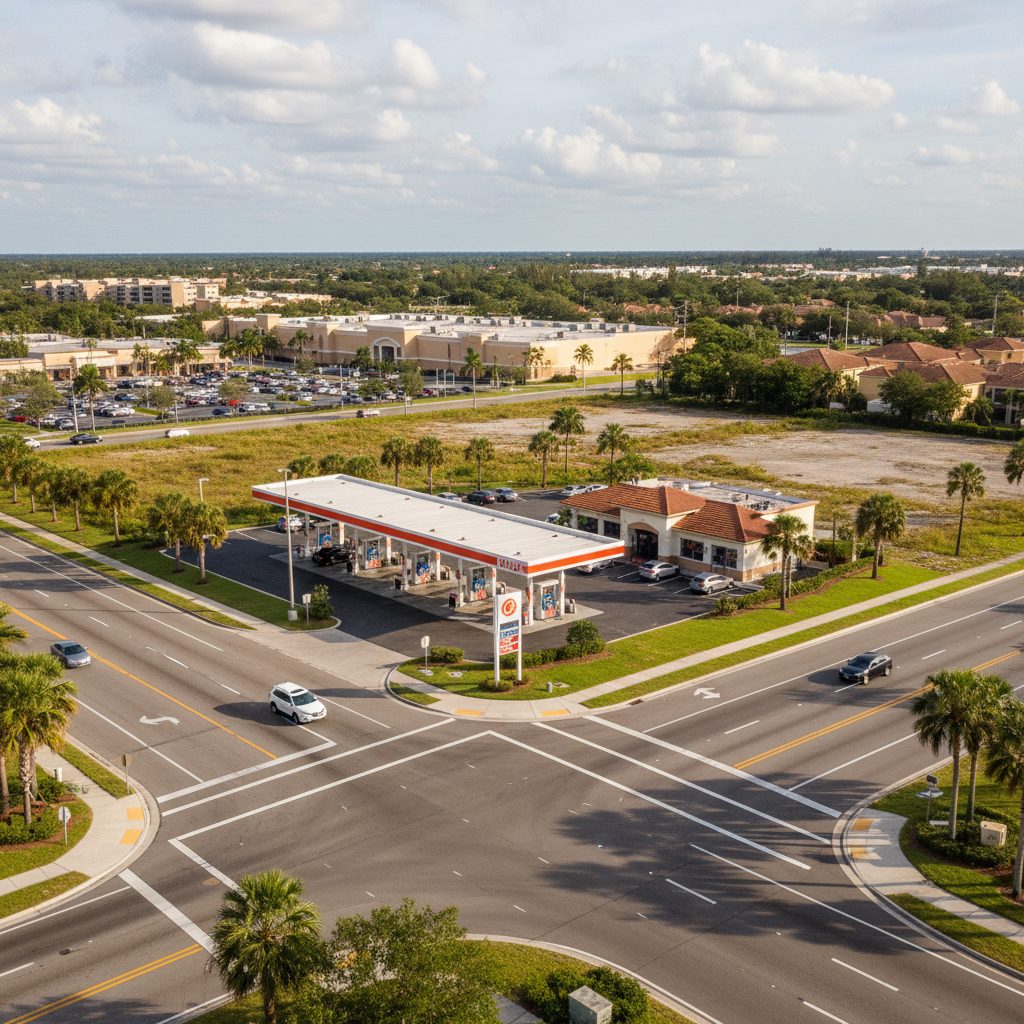
Signal placement is a site-specific factor that dramatically affects access quality. A gas station at a signalized intersection on a 45 MPH arterial benefits from a traffic light that slows approaching vehicles and creates a natural decision point. A station on an unsignalized stretch of the same road — even at equivalent AADT — will capture materially fewer impulse stops. In Florida's I-95 corridor cities like Doral, Hialeah, and Pompano Beach, signalized corner locations can command 20–35% premiums in both fuel volume and real estate value over mid-block comparables.
Ingress/Egress and Curb Cut Configuration
Ingress and egress quality is where strong AADT sites frequently disappoint. A station with a single right-in/right-out access on a divided six-lane arterial effectively excludes left-turning traffic from both directions, cutting the addressable customer base in half. Full-access driveways — or a combination of a primary signalized access and a secondary side-street cut — are the gold standard. In Florida, FDOT regulates driveway access spacing and turn lane requirements, and many older sites have non-conforming access that cannot be upgraded without costly permitting battles.
Canopy and pump island orientation relative to the access points is equally important. A site where the fuel island approach requires a sharp turn across a busy interior drive creates friction that reduces transaction completion rates. Sites designed with generous throat depth, clear sightlines from the street, and easy tank truck access score higher on both customer experience and operational efficiency metrics. [[/|Florida gas station listings]] evaluated by The Gas Station Group always include a detailed access and circulation analysis as part of site underwriting.
Daytime/Nighttime Population and Competition Radius
Daytime population — workers, commuters, and visitors present in a trade area during business hours — is often more relevant to a gas station's fuel volume than residential population. A station near a major employment center, a Florida hospital campus, or a distribution hub like the Port of Miami or Port of Tampa will generate consistent daytime transaction volume that persists even in lower-density residential neighborhoods. Nighttime population — permanent residents — anchors the convenience store component more than the fuel pad.
Competition radius analysis should extend beyond the immediately visible cross-street competitor. In Florida's dense metro markets, a three-mile radius on a major arterial can contain 6–12 operating fuel retail locations. Effective competition mapping identifies not just current competitors but also recently closed sites, pending development approvals, and land parcels zoned for fuel retail use — all of which affect pricing discipline and volume projections. A specialist broker with Florida market knowledge can pull this competitive context rapidly for any target site.
Hurricane Evacuation Corridors and Demand Surge Events
Florida's unique geography creates a site selection variable that does not exist in most other states: hurricane evacuation corridor designation. Florida's primary hurricane evacuation routes — including US-1, US-17, US-19, US-27, and major state roads connecting coastal zones to I-75, I-95, and the Turnpike — experience extraordinary demand surge events in the 48–72 hours preceding a hurricane landfall. Gas stations on these corridors can transact months of normal volume in a three-day window and play a critical public infrastructure role under Florida's fuel resiliency statutes.
Sites on designated evacuation routes that comply with Florida's Emergency Fuel Site program — which requires generator backup capacity to maintain pump operations during power outages — carry a measurable premium among both operators and investors. The 2017 Hurricane Irma evacuation, which produced the largest peacetime evacuation in U.S. history with over 6 million Floridians on the road, demonstrated that sites without generator capacity lost days of peak volume to competitors who maintained power. For buyers evaluating [[/|Florida gas station opportunities]], evacuation corridor designation and generator compliance status should be standard checklist items.
Frequently Asked Questions
Speak With a Florida Gas Station Specialist
Request a confidential consultation or off-market opportunities and pricing through our contact page, or call +1-305-518-1545. The Gas Station Group is headquartered at 8603 S Dixie Hwy, Miami, FL 33143. Principal: Bobby Berrido.
Continue Reading