Electric vehicle adoption in Florida is real, measurable, and accelerating — but the timeline for it to materially disrupt fuel retail economics is longer and more nuanced than either EV advocates or fossil fuel absolutists claim. The Gas Station Group tracks this evolution closely because it directly affects how we underwrite Florida gas station acquisitions, how we advise sellers on exit timing, and how forward-thinking operators are repositioning their sites today.
Florida is the third-largest EV market in the United States, with the highest concentration of registered EVs clustered in Miami-Dade, Broward, Palm Beach, and the I-4 corridor. But adoption curves look very different along I-10 in the Panhandle, in agricultural Central Florida, or in the rural corridors where truck traffic dominates demand. Understanding this geographic heterogeneity is essential to any honest assessment of EV's impact on Florida fuel retail real estate.
Florida's Realistic EV Adoption Curve
Florida's registered EV count crossed 250,000 in 2023 and is projected to reach 1.5–2 million by 2030 under moderate adoption scenarios, representing roughly 10–12% of the state's vehicle fleet. That penetration level is meaningful but does not translate to an equivalent reduction in fuel demand — EVs disproportionately replace second and third household vehicles used for local urban trips, not the primary long-distance driving vehicle or the commercial vehicle fleet that dominates fuel volume at highway corridor sites. ICE vehicle sales continue to account for over 80% of Florida new vehicle registrations as of this writing.
The practical implication for fuel retail underwriting is that sites with heavy local suburban traffic in South Florida metro markets will feel EV demand erosion sooner and more acutely than sites in rural Central Florida, along the I-10 Panhandle route, or at I-75 truck-oriented interchanges. Investors underwriting 10-year hold periods on high-AADT urban sites in Broward or Miami-Dade should model a 5–10% fuel volume reduction by year 7–10 in their base case. Sites with strong diesel and commercial fleet components face a longer dislocation horizon given the slower EV penetration curve for heavy trucks.
Dwell-Time Economics and C-Store Traffic Resilience
The most frequently cited opportunity in the EV transition for gas station operators is dwell-time monetization. A gasoline fill-up takes 4–6 minutes; a DC fast charge takes 20–45 minutes at current technology. That additional dwell time creates a structural opportunity to drive c-store, food service, and amenity revenue that the quick-fill gasoline transaction never could. Sites that invest in compelling food service — hot food, national QSR partnerships, coffee programs — are already demonstrating that inside revenue can more than offset modest fuel volume erosion.
Florida convenience store operators who have invested in strong foodservice — particularly those in high-density urban markets along the I-95 corridor — are reporting inside gross profit margins that dwarf their fuel contributions. A well-operated Florida c-store with foodservice can generate $800,000–$1.2M in annual inside gross profit independent of fuel. Fuel supply advisory and site repositioning conversations should include an honest assessment of whether a given site's real estate footprint and traffic pattern support the dwell-time c-store model that makes EV charging economically viable.
Hybrid Site Configurations and Charging Infrastructure
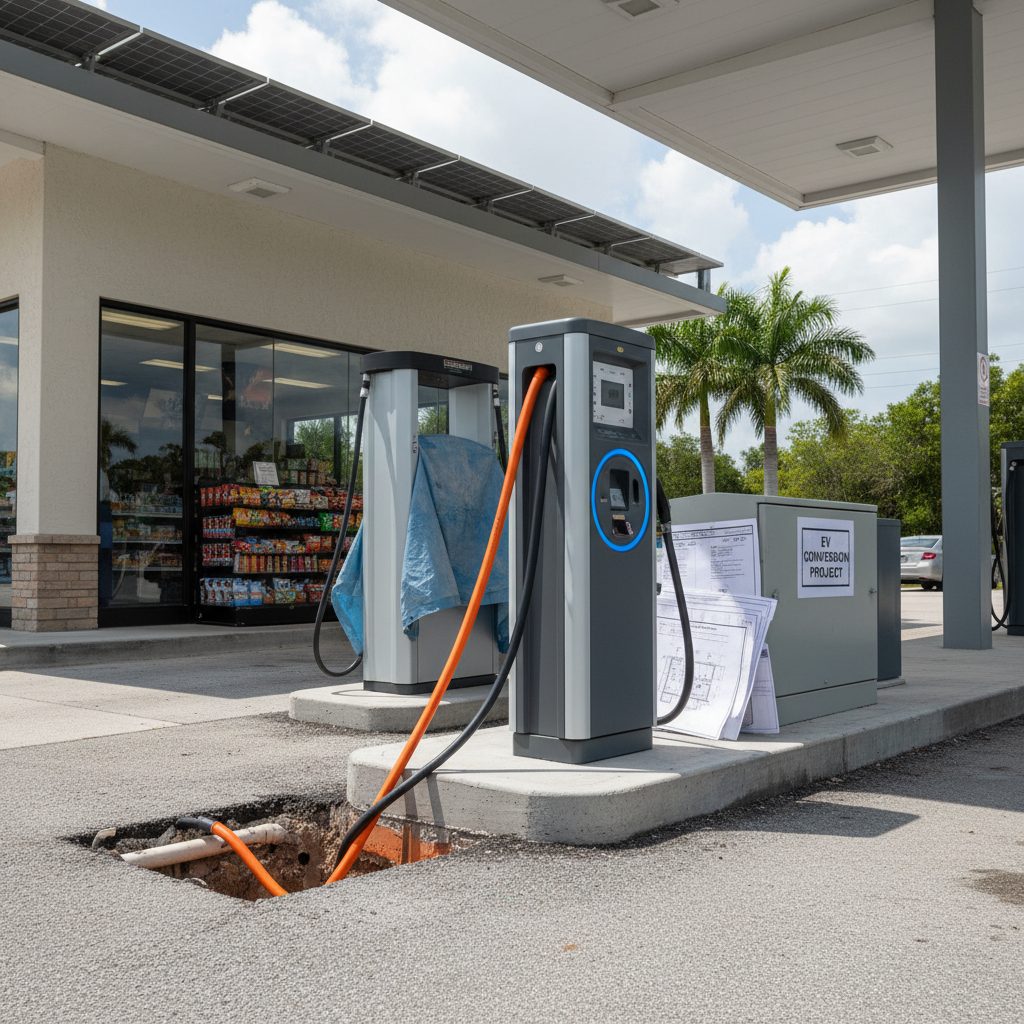
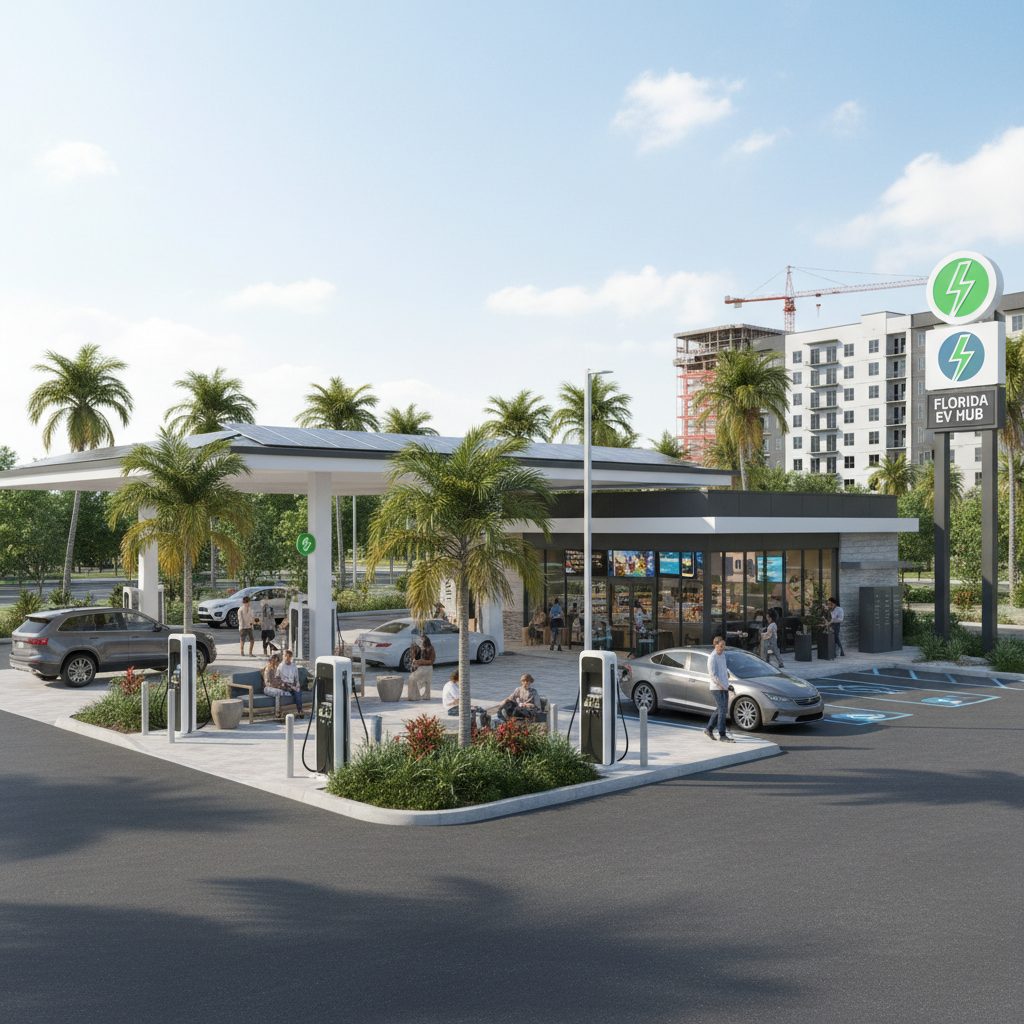
The practical near-term configuration for most Florida gas stations will be hybrid: existing fuel dispensers serving the 90%+ ICE vehicle base, supplemented by 2–6 DC fast charging stalls positioned to generate inside revenue through extended customer dwell. The economics of DC fast charging hardware have improved substantially, with Level 3 chargers now available in the $25,000–$45,000 per stall range before installation, and federal NEVI program funding available to offset costs on designated Florida EV corridor sites along I-95, I-75, I-10, and the Turnpike.
Site geometry is the binding constraint. A fuel retail site needs a minimum 4,000–6,000 square feet of additional paved surface area to accommodate charging stalls, cable management, and the required setbacks — space that many urban Florida sites simply do not have. Larger interstate interchange sites and travel centers on Florida's Turnpike and I-75 are far better positioned for hybrid configurations than urban infill locations in Miami or Fort Lauderdale where land constraints are severe.
Cap-Rate Impact on Florida Fuel Retail in the 5–10 Year Horizon
The investment market has not yet repriced Florida fuel retail assets for EV risk in any meaningful way. Cap rates on well-located NNN gas station investments in Florida remain at 5.0–6.5% for institutional-quality sites, driven by strong lease coverage ratios, durable cash flow, and limited available supply of quality fuel retail real estate in high-growth markets. However, institutional investors running 10-year DCF models are beginning to apply modest fuel volume haircuts in years 6–10 for South Florida urban sites.
The more immediate cap-rate pressure will likely come from sites that fail to invest in the dwell-time c-store and EV transition — not from macro EV adoption curves. A Florida gas station with a dated c-store, no foodservice, and no EV infrastructure plan will face buyer scrutiny at exit that a proactively repositioned competitor will not. Florida gas station investment sale strategies for the current market should include a credible capital expenditure roadmap for EV readiness, even if implementation is 3–5 years out, to defend exit valuation in an institutional underwriting process.
Frequently Asked Questions
Speak With a Florida Gas Station Specialist
Request a confidential consultation or off-market opportunities and pricing through our contact page, or call +1-305-518-1545. The Gas Station Group is headquartered at 8603 S Dixie Hwy, Miami, FL 33143. Principal: Bobby Berrido.
Continue Reading