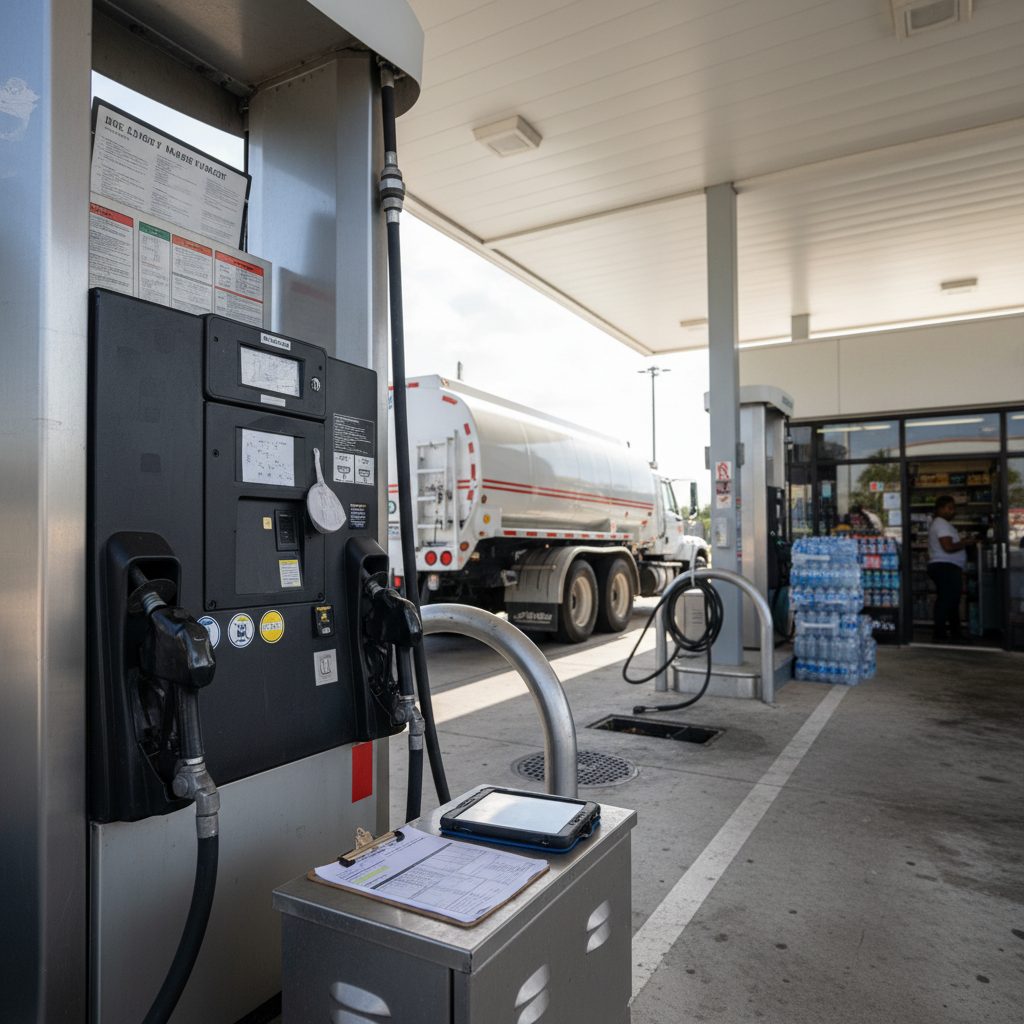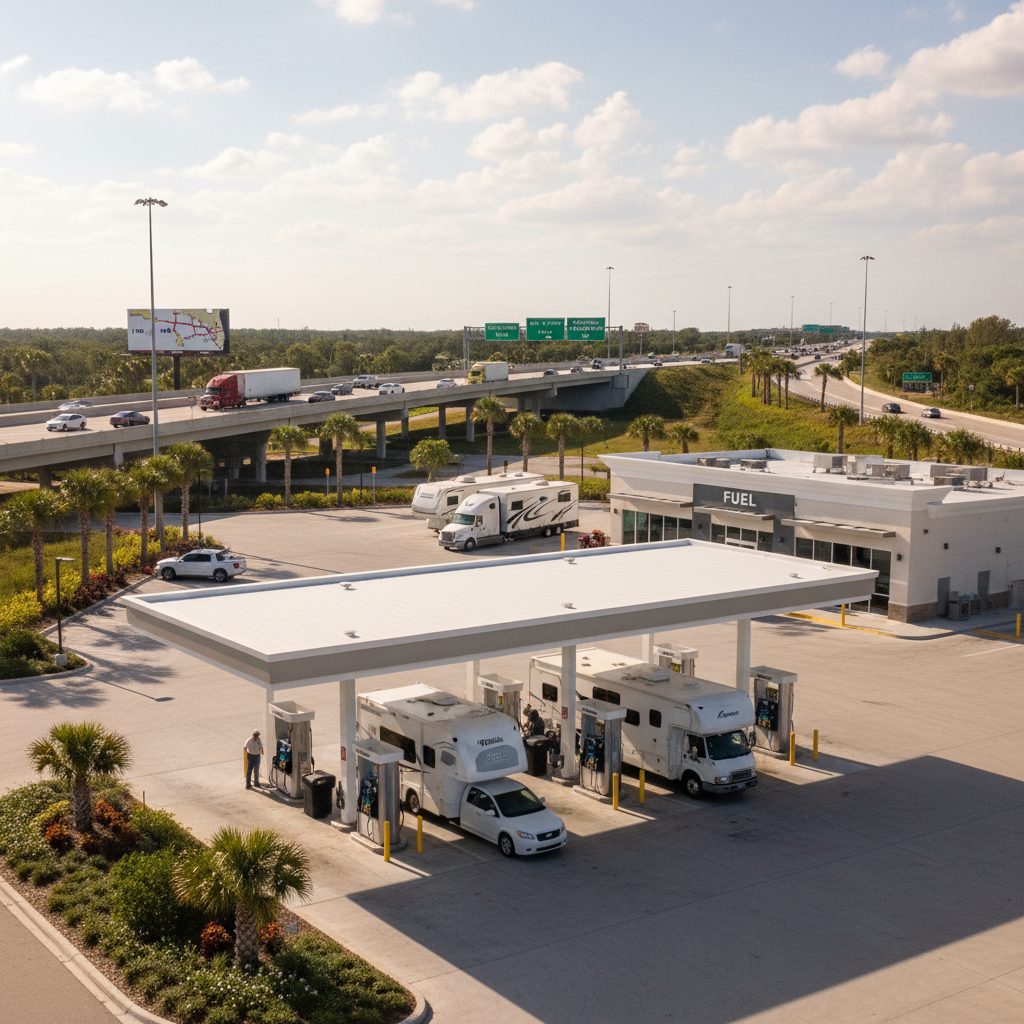
Florida's four primary interstate corridors — I-95, I-75, I-10, and Florida's Turnpike — each generate distinct fuel-retail demand profiles shaped by traffic composition, port linkage, tourist concentration, and corridor length. Understanding how demand differs across these corridors is foundational for any investor or operator evaluating Florida fuel-retail acquisitions, site selection, or portfolio composition strategy.
The differentiation between corridors matters not just for volume forecasting but for asset-type selection. Truck stops for sale in Florida perform against a completely different demand model than convenience-fuel sites along tourist-dominated stretches — and the spread between those asset types widens considerably depending on which corridor the site anchors.
I-95: The Eastern Seaboard Spine
I-95 is Florida's highest-traffic interstate, running 382 miles from the Georgia border at Jacksonville south through Daytona Beach, the Space Coast, Fort Lauderdale, and terminating at US-1 in Miami. AADT counts on I-95 in Broward and Miami-Dade counties regularly exceed 150,000–200,000 vehicles per day on peak segments, with significant fleet and commercial vehicle penetration from Port Everglades and PortMiami freight distribution. The fuel-retail demand profile is mixed: urban segments through Fort Lauderdale and Miami demand high-throughput convenience-fuel sites with strong inside-sales programs, while northern Florida segments near Daytona and Jacksonville transition to a more traditional highway traveler profile.
Port Everglades — one of the busiest container and petroleum ports in the southeastern United States — generates consistent inbound freight distribution traffic along I-95's Broward segment, supporting dedicated truck fueling operations at several sites between Exits 19 and 33. PortMiami, while less directly I-95-linked, pushes significant freight volume onto I-95 via the Port of Miami Tunnel and SR-836, reinforcing southernmost I-95 segment demand. Operators on this corridor compete on dispensers, truck lanes, and loyalty fleet card acceptance as much as on price.
I-75 and I-10: Freight and Sun Belt Connectivity
I-75 runs 471 miles from Naples in Southwest Florida north through Tampa, Gainesville, and Lake City to the Georgia border, serving as Florida's primary freight artery for Sun Belt distribution and as the tourist corridor for the Gulf Coast. The Tampa Bay segment carries AADT in excess of 100,000 vehicles daily, with significant commercial vehicle density from the Port of Tampa — Florida's largest port by tonnage — and the adjacent industrial distribution base in Hillsborough and Pasco counties. Truck stop and travel center demand is strongest at the I-75/I-10 interchange in the Lake City area and at major exit clusters around Tampa's ring roads.
I-10 crosses northern Florida east-to-west for 362 miles from the Jacksonville interchange with I-95 through Tallahassee and Pensacola to the Alabama border. It is Florida's most freight-dominated corridor by vehicle-type composition, with commercial truck penetration regularly exceeding 20% of total AADT on western Florida segments. Fuel-retail assets on I-10 tilt heavily toward truck-capable formats — sufficient diesel canopy clearance, DEF dispensing, 100-plus truck parking spaces, and driver amenities. Jacksonville's I-10/I-95 interchange cluster is among the highest-demand truck-stop locations in the state, linking the Jacksonville port complex with transcontinental freight routing.
Florida's Turnpike: The Tourism and Commuter Corridor
Florida's Turnpike runs approximately 320 miles from its northern terminus near Wildwood south through Orlando, through the Treasure Coast, and into Miami-Dade, functioning simultaneously as a Miami-to-Orlando tourism artery, a South Florida commuter spine, and a freight bypass for operators avoiding I-95 congestion. Turnpike service plazas operated by HMS Host dominate captive-audience fueling at designated stops, but privately owned stations at major Turnpike interchanges — particularly at SR-528, SR-60, and the Homestead Extension — capture substantial overflow demand.
The Turnpike's demand profile is distinguished by high average transaction size — tourists and long-haul travelers fill tanks fully rather than topping off — and strong ancillary inside-sales performance driven by beverage, snack, and lottery demand from commuters on the South Florida segments. Fuel-retail assets at Turnpike interchanges in the Orlando metro and South Florida segments command premium pricing and tight cap rates, reflecting both traffic volume and the limited supply of quality fuel-retail locations at major interchange nodes. Explore Florida truck stop investment opportunities along these corridors for the most traffic-validated fuel-retail assets in the state.
Where Truck Stops Win Versus Convenience-Fuel Formats
The corridor analysis resolves to a straightforward asset-type selection framework: I-10 western segments, I-75 north of Tampa, and I-95 Jacksonville/Daytona segments favor truck-stop formats with diesel-dominant revenue, driver amenities, and scale parking. I-95 south of Palm Beach, the Turnpike Orlando metro segments, and I-75 Naples-to-Tampa segments favor high-throughput convenience-fuel formats with strong inside-sales programs oriented toward tourist and commuter traffic.
Hybrid sites — large-format travel centers with both truck diesel and consumer gasoline lanes, strong foodservice, and c-store programs above $150,000 monthly — perform well at corridor interchange nodes that serve both freight and consumer traffic simultaneously. The Port of Tampa, PortMiami, and Port Everglades linkages ensure that freight-linked demand remains structurally supported along their respective corridors regardless of consumer driving cycle fluctuations, providing a demand floor that purely tourist-dependent sites lack. AADT counts above 60,000 vehicles daily are the minimum threshold for truck-stop viability; consumer-focused convenience-fuel sites can underwrite from AADT counts of 25,000-plus with strong directional capture rates.
Frequently Asked Questions
Speak With a Florida Gas Station Specialist
Request a confidential consultation or off-market opportunities and pricing through our contact page, or call +1-305-518-1545. The Gas Station Group is headquartered at 8603 S Dixie Hwy, Miami, FL 33143. Principal: Bobby Berrido.
Continue Reading