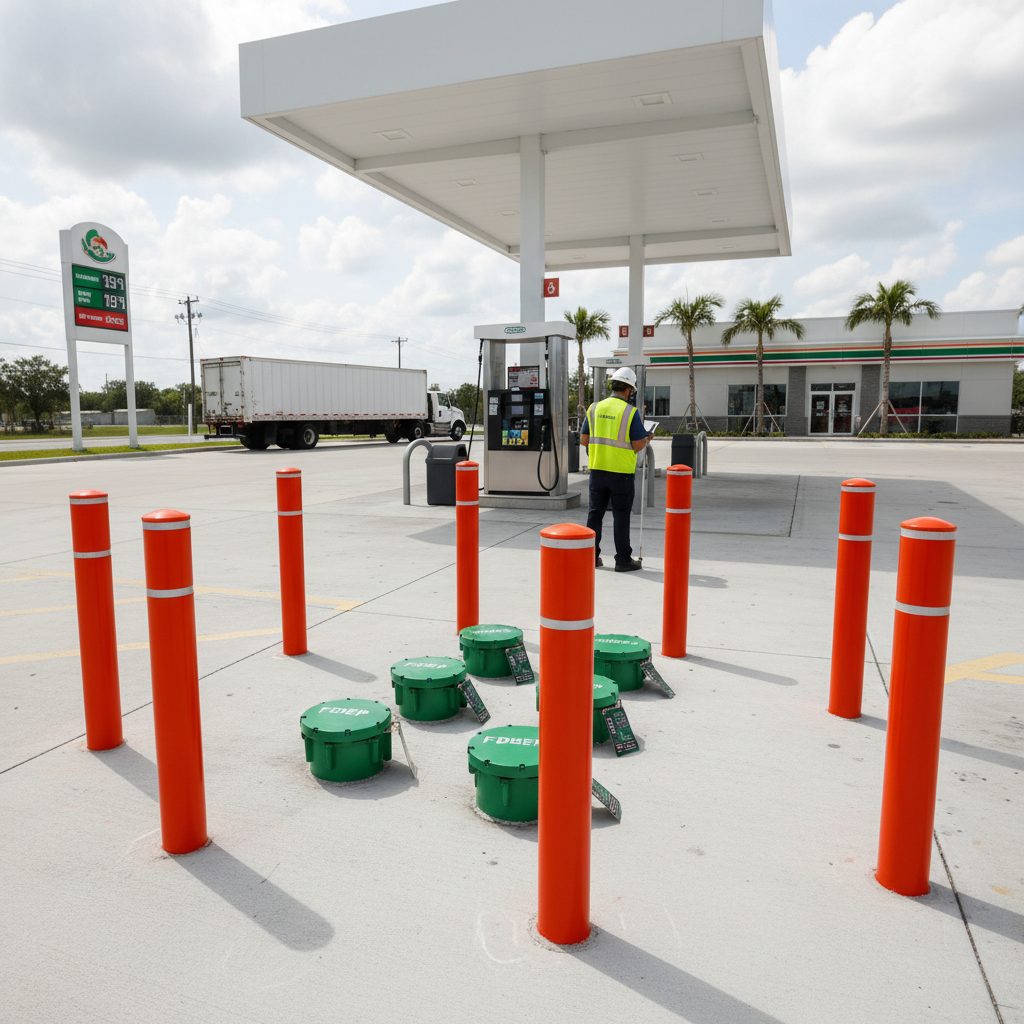
Florida's underground storage tank (UST) regulatory framework — administered by the Florida Department of Environmental Protection — is among the most operationally demanding in the United States, combining federal EPA UST requirements with state-specific registration, financial responsibility, certified operator, and leak detection mandates. For any owner, operator, or buyer of a Florida gas station, UST compliance is not a background administrative function — it is an active operating obligation with real enforcement consequences and material transaction implications.
Whether you are operating an existing site, acquiring a Florida gas station through a buyer-represented transaction, or transferring ownership, understanding the full scope of FDEP UST obligations from registration through certified operator requirements is foundational to managing liability and maintaining good regulatory standing.
Registration and Financial Responsibility Requirements
All USTs in Florida must be registered with the FDEP through the Storage Tank and Petroleum Program, with annual registration fees paid per tank. Registration records must reflect current ownership, tank age, construction type (single-wall vs. double-wall, bare steel vs. fiberglass), and installed leak detection equipment. Ownership changes — including business acquisitions, estate transfers, and entity conversions — require updated registration within 30 days of the change; failure to update registration is a compliance violation that can affect IPTF eligibility and transfer-of-ownership approvals.
Financial responsibility — the requirement to demonstrate ability to fund UST cleanup — is met in Florida through one of several approved mechanisms: state IPTF participation (for qualifying operators), commercial insurance from an approved insurer, a guarantee by a financial-test-qualified parent entity, or a surety bond. The IPTF program provides the most common financial responsibility mechanism for independent Florida operators and requires annual compliance with FDEP-specified reporting and certified operator obligations to maintain eligibility.
Monthly Leak Detection and Equipment Requirements
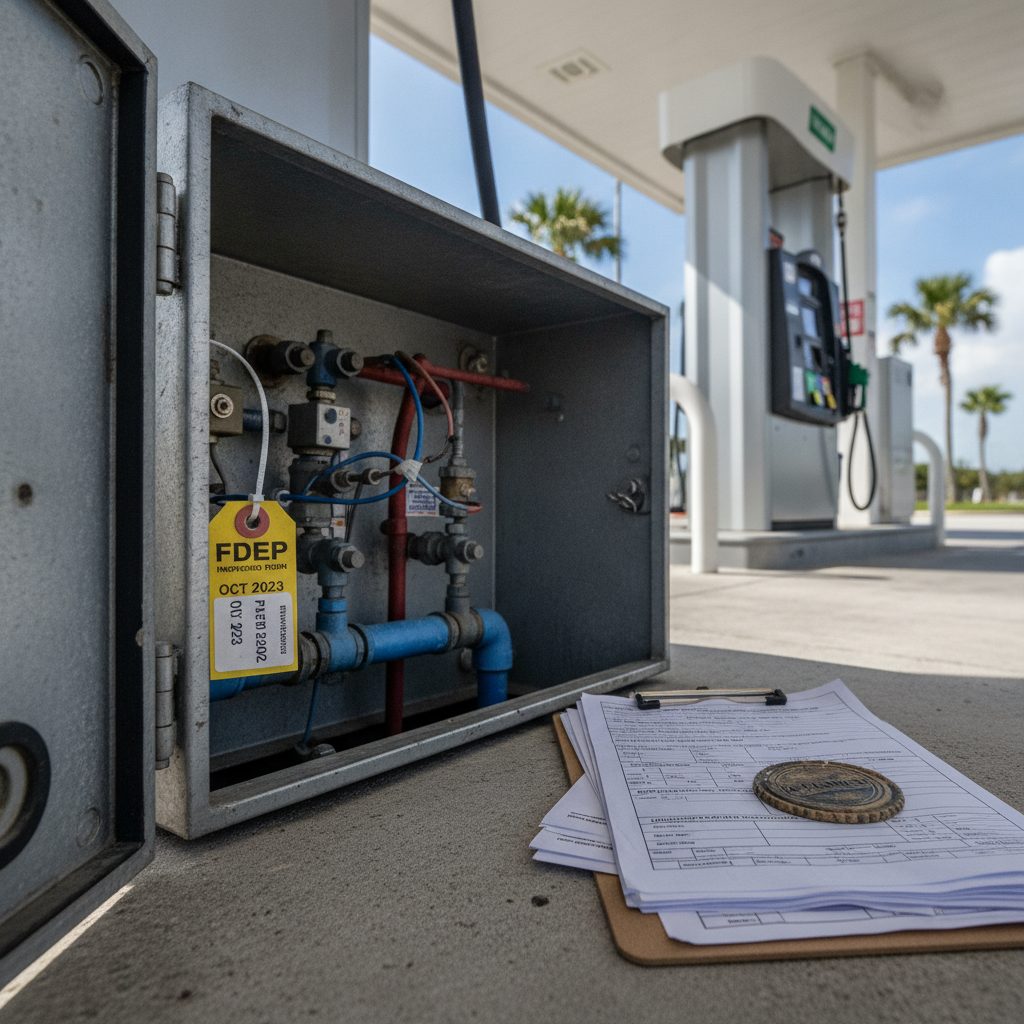
Florida requires continuous or monthly leak detection for all regulated UST systems, with specific methods prescribed based on tank age and construction type. Automatic tank gauging (ATG) systems — such as Veeder-Root or Franklin Fueling — must be tested annually by a certified contractor and configured to generate monthly leak detection reports that are retained on-site for three years and produced immediately upon FDEP inspector request. Dispenser sumps, spill containment buckets, and overfill prevention devices must be inspected and tested on FDEP-prescribed schedules.
Florida's requirement for interstitial monitoring on double-wall tank systems means that ATG alarm events — even minor sensor alarms — must be investigated and documented. Operators who acknowledge ATG alarms without investigation and documentation create both regulatory exposure and potential IPTF claim issues: FDEP inspectors review ATG data downloads during compliance inspections and can identify alarm events that were not properly addressed. A disciplined alarm-response log, maintained by site staff and reviewed monthly by the certified operator, is the single most important operational practice for UST compliance in Florida.
Class A, B, and C Operator Obligations
The EPA's 2015 UST regulations, adopted by Florida through FDEP rulemaking, established a Class A/B/C operator training and designation framework. The Class A operator — typically the owner or senior management representative — is responsible for overall regulatory compliance and must complete approved training and register with FDEP. The Class B operator is the on-site compliance manager responsible for implementing the UST compliance program, conducting or overseeing required inspections, and maintaining compliance documentation; Class B designation requires FDEP-approved training and is the most operationally intensive role.
Class C operators are site-level employees responsible for responding to emergencies — spills, overfills, equipment alarms — and must be trained before operating the fueling system. Every Florida gas station must have designated, currently trained Class A, B, and C operators registered with FDEP, with updated designations filed within 30 days of any personnel change. Undesignated or lapsed-certification sites are a common compliance finding during FDEP inspections and are a red flag in buyer due diligence reviews of Florida gas station acquisitions.
Transfer of Ownership: Process and Compliance Requirements
Florida's transfer-of-ownership process for UST-regulated gas stations requires the seller to complete FDEP Form 62-761.900(1) — the Storage Tank Facility Transfer of Ownership notification — and submit it to the FDEP district office with applicable registration fees within 30 days of the ownership transfer. Buyers who fail to submit the transfer notification inherit the seller's compliance status, including any outstanding violations, unresolved inspection findings, or open enforcement orders that attach to the facility registration rather than the individual owner.
Best practice for Florida gas station acquisitions is to conduct a FDEP compliance audit — including retrieval of the full facility compliance file from the FDEP Storage Tank database — as part of the due diligence process. This audit identifies outstanding violations, lapsed certified operator designations, failed leak detection tests, and open discharge cases that require disclosure and negotiation before closing. The Gas Station Group's buyer advisory process includes FDEP compliance review as a standard transaction component for all Florida gas station acquisitions. Contact us at (305) 518-1545 to discuss how compliance status affects deal structure and pricing.
Frequently Asked Questions
Speak With a Florida Gas Station Specialist
Request a confidential consultation or off-market opportunities and pricing through our contact page, or call +1-305-518-1545. The Gas Station Group is headquartered at 8603 S Dixie Hwy, Miami, FL 33143. Principal: Bobby Berrido.
Continue Reading