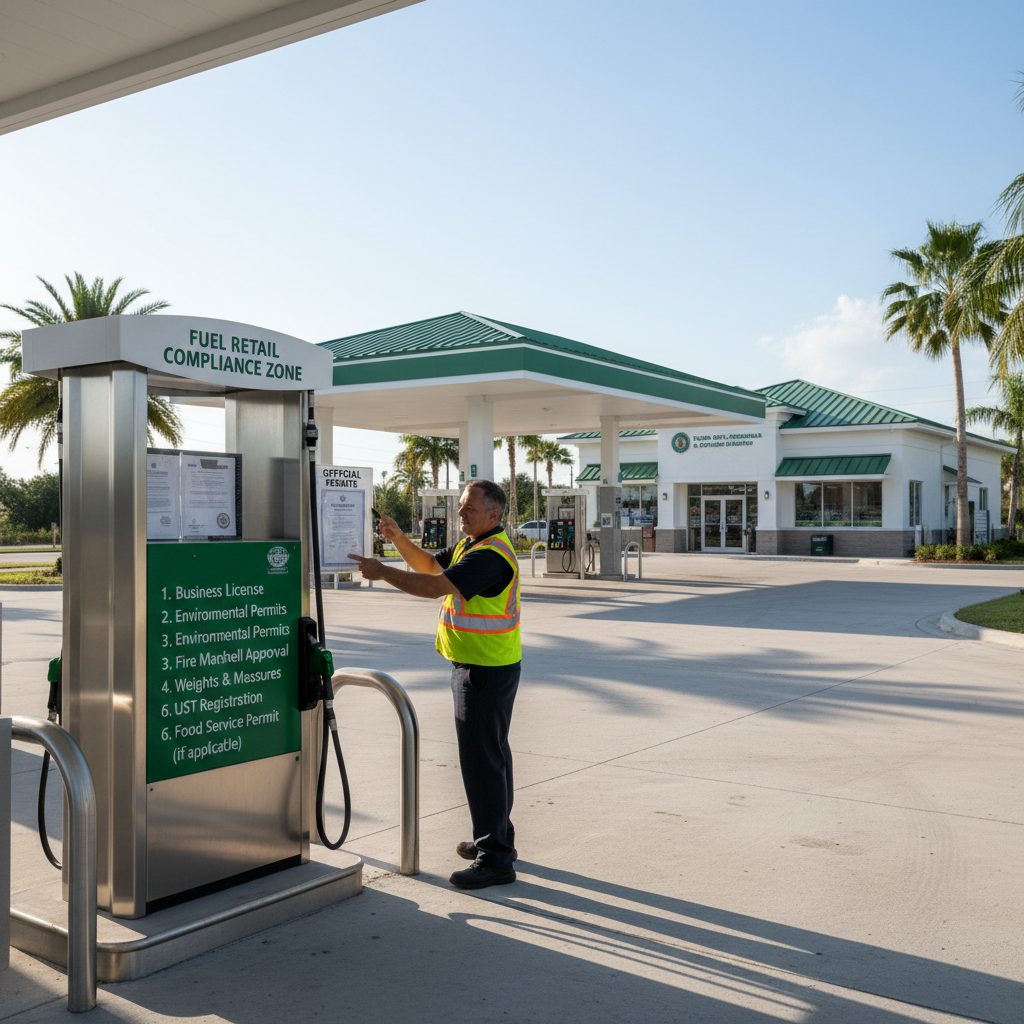
Acquiring or operating a Florida gas station requires navigating one of the most comprehensive licensing and compliance frameworks in the country. From FDEP storage tank registration to DBPR food service licensing, from FDACS weights and measures certification to local occupational license requirements, the permit stack for a Florida fuel retail operation touches multiple state agencies and local jurisdictions — and missing any single element can trigger fines, operational shutdowns, or deal delays.
The Gas Station Group has guided hundreds of Florida fuel retail transactions through the licensing and permit transfer process. Understanding what is required, who issues it, and how licenses transfer on a sale is essential knowledge for every buyer, seller, and operator in this market. The checklist below covers the primary state and local requirements — but always engage a Florida attorney with fuel retail experience for site-specific compliance review.
FDEP Storage Tank Facility ID and Environmental Compliance
Every Florida gas station with underground storage tanks must be registered with the Florida Department of Environmental Protection and maintain a state-assigned Facility ID number. This registration is the foundation of FDEP oversight and is linked to the site's compliance history in the OCULUS database, which tracks inspection records, discharge reports, cleanup site status, and tank installation permits. A change of ownership requires the new owner to notify FDEP within 30 days of closing and update the Facility ID registration — a step that is frequently overlooked in transactions handled by generalist brokers.
Tank compliance includes: annual inspection records under Rule 62-761, FAC; secondary containment verification; leak detection system documentation (interstitial monitoring or statistical inventory reconciliation); and cathodic protection testing for steel tanks. Sites with tanks installed before 1998 must have completed the mandatory upgrade to double-walled construction and approved leak detection. Buyers should pull the full FDEP OCULUS file for every target acquisition and verify that all current compliance documentation is in order before closing, since environmental violations can result in operational shutdowns independent of the real estate transaction.
DBPR, FDACS, and Retail Operating Licenses
Gas stations that sell food — including packaged goods, prepared food, or hot food — require a food permit from the Florida Department of Business and Professional Regulation (DBPR), Division of Hotels and Restaurants. The permit type depends on the scope of food service: a basic c-store selling packaged items requires a different permit class than a location with a deli counter or hot food preparation. DBPR conducts routine inspections, and permit violations are public record, making a review of DBPR inspection history for any acquisition an important due diligence step.
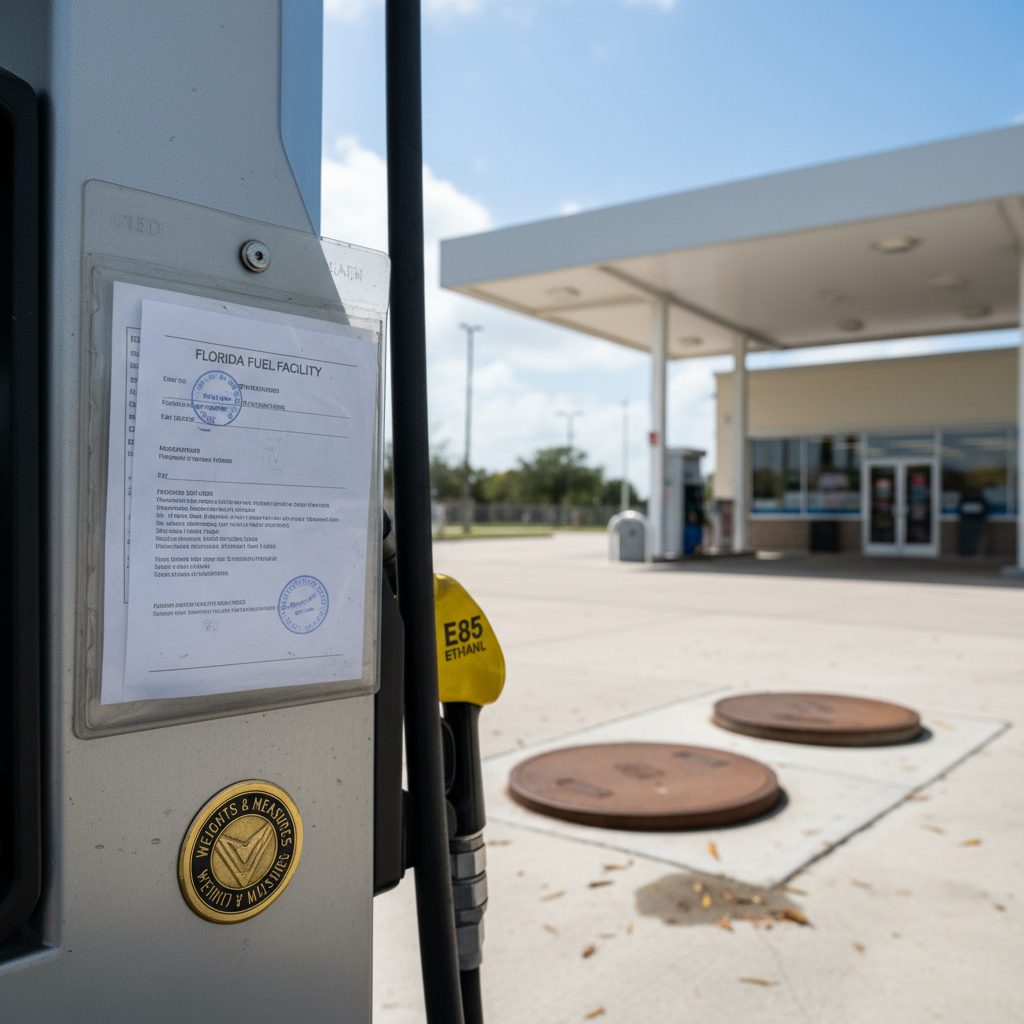
The Florida Department of Agriculture and Consumer Services (FDACS) oversees weights and measures certification for all fuel dispensers in Florida. Every pump on the site must carry a current FDACS inspection seal, and pumps found out of tolerance are red-tagged and taken out of service immediately. FDACS also licenses petroleum products dealers and oversees the Florida fuel quality testing program, which conducts random fuel sample testing for compliance with ASTM standards. Buyers should verify that all dispensers carry current certification seals and request records of any recent FDACS citations before closing. Florida gas station buyers and sellers who work with a specialist broker will have these items addressed systematically in due diligence.
Lottery, Tobacco, Alcohol, and Specialty Licenses
Florida Lottery retailer authorization is issued by the Florida Lottery Commission and is a significant revenue contributor for most c-stores — Florida lottery sales average $30,000–$80,000+ annually at a well-positioned site, with a 5% retailer commission. Lottery retailer agreements are not automatically transferable on a sale; the new operator must apply for a new authorization, which requires a background check and site inspection. Gaps in lottery authorization post-closing represent an immediate revenue interruption that should be anticipated and mitigated in the transaction timeline.
Tobacco and alcohol licenses in Florida are issued at the county or municipal level through the Florida Division of Alcoholic Beverages and Tobacco (ABT). A gas station selling beer and wine requires a 2APS license (beer, wine, and spirits for consumption off-premises), which is subject to county quota limitations in many Florida counties. In quota-constrained markets like Miami-Dade and Broward, an existing 2APS license can carry a market value of $50,000–$150,000+, making it a material asset component that must be addressed in the purchase agreement. License transfer applications must be filed with ABT prior to closing and can take 30–90 days to process.
Local Zoning, Occupational Licenses, and Hurricane Fuel Resiliency
Local occupational licenses — required by the municipality or county in which the site operates — must be transferred or reissued in the new operator's name at closing. In most Florida jurisdictions, the occupational license transfer requires submitting a change-of-ownership application, paying a transfer fee, and in some cases passing a local zoning or fire inspection. Sites in municipalities with active code enforcement programs — common in South Florida cities along I-95 — should be inspected for outstanding code violations before closing, as code violations run with the property and become the buyer's problem at transfer.
Florida's fuel resiliency program, established under Florida Statute §252.385, requires certain fuel retail sites to maintain backup generator capacity to operate fuel dispensers during extended power outages. Sites on designated hurricane evacuation routes are the primary focus, but the program has been expanded following Hurricane Irma and Hurricane Ian to encourage broader generator adoption. Compliance with the resiliency program is a licensing matter as well as an operational resilience issue, and sites that fail to meet generator requirements risk exclusion from emergency fuel supply networks that activate during major storm events. Florida gas station buyers and sellers should verify generator compliance status for any site on a designated evacuation corridor.
Frequently Asked Questions
Speak With a Florida Gas Station Specialist
Request a confidential consultation or off-market opportunities and pricing through our contact page, or call +1-305-518-1545. The Gas Station Group is headquartered at 8603 S Dixie Hwy, Miami, FL 33143. Principal: Bobby Berrido.
Continue Reading