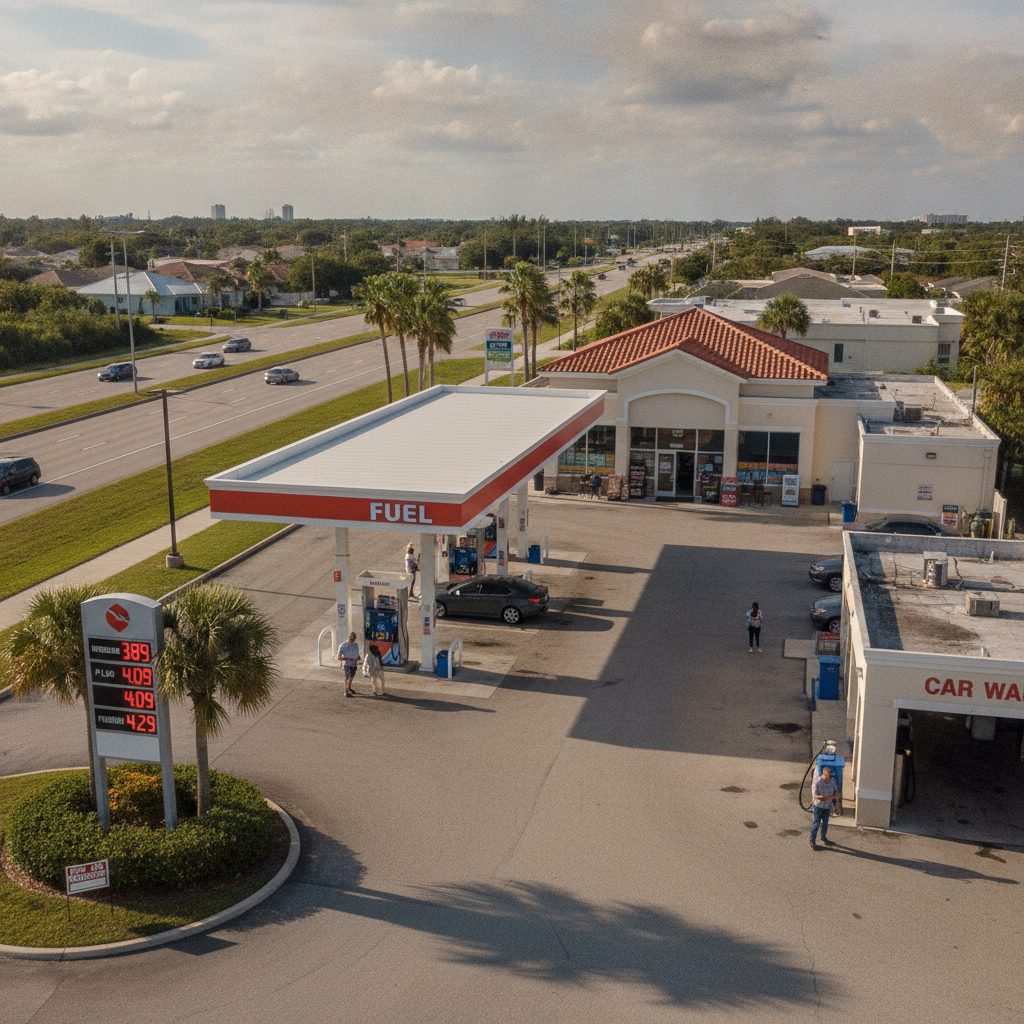
A gas station is valued by splitting it into its parts: the real estate, the fuel business, the store business and any extra income such as a car wash. Each part is priced on its own evidence. The total is then checked against comparable sales, the cost to build new, and whether the cash flow can carry a loan. A single rule-of-thumb multiple skips all of that, and it is the fastest way to misprice a station.
This guide walks through the method we use on Florida stations, whether you are an owner thinking about selling, a buyer underwriting a purchase, or an investor looking at a leased site. It covers the records to collect, how earnings are adjusted, what buyers deduct, and how the final number is tested.
Why a Gas Station Is Not Valued Like a Normal Business
Most small businesses are priced on a multiple of earnings. A gas station is different because it is part real estate, part operating business and part regulated environmental site. Those three pieces carry different risks and attract different buyers and lenders.
A lender financing the real estate wants a market rent and a cap rate. A lender financing the business wants cash flow that covers the debt payments. An environmental consultant wants tank records. A valuation that blends all of this into one number looks fine on paper and then falls apart in underwriting.
Step 1: Separate the Value Components
Start by breaking the station into the pieces a buyer will actually pay for. Adding them up separately shows which part is strong and which is weak, and it prevents counting the same dollar twice.
One common error: applying a business multiple to cash flow that assumes free rent on real estate the buyer must also buy or lease. If the seller occupies the site rent-free, deduct a market rent before valuing the business.
Real estate
If the land and building convey, value them on comparable commercial and fuel-site sales, or by capitalizing the fair market rent an operator would pay for the site. Whether fee-simple title conveys is the single largest structural variable in any station price. See real estate value versus business value for how the two are separated.
Fuel business
Fuel earnings are sustainable gallons multiplied by the cents per gallon the site can actually earn under its supply agreement. Gallons on their own say little. A station that grew volume by pricing at cost has not grown value.
Store business
Inside sales are valued on gross profit by department, such as beverages, beer and wine, tobacco, snacks and food service, less the labor to run them. Pass-through categories like lottery and money orders inflate revenue but are counted at commission, not ticket value.
Ancillary income
Car wash, ATM, air and vacuum, propane, subtenant rent and delivery pickup income each add value when they are documented. Licenses that enable high-margin categories, alcohol especially, matter because they are slow to replace.
Step 2: Collect and Verify the Records
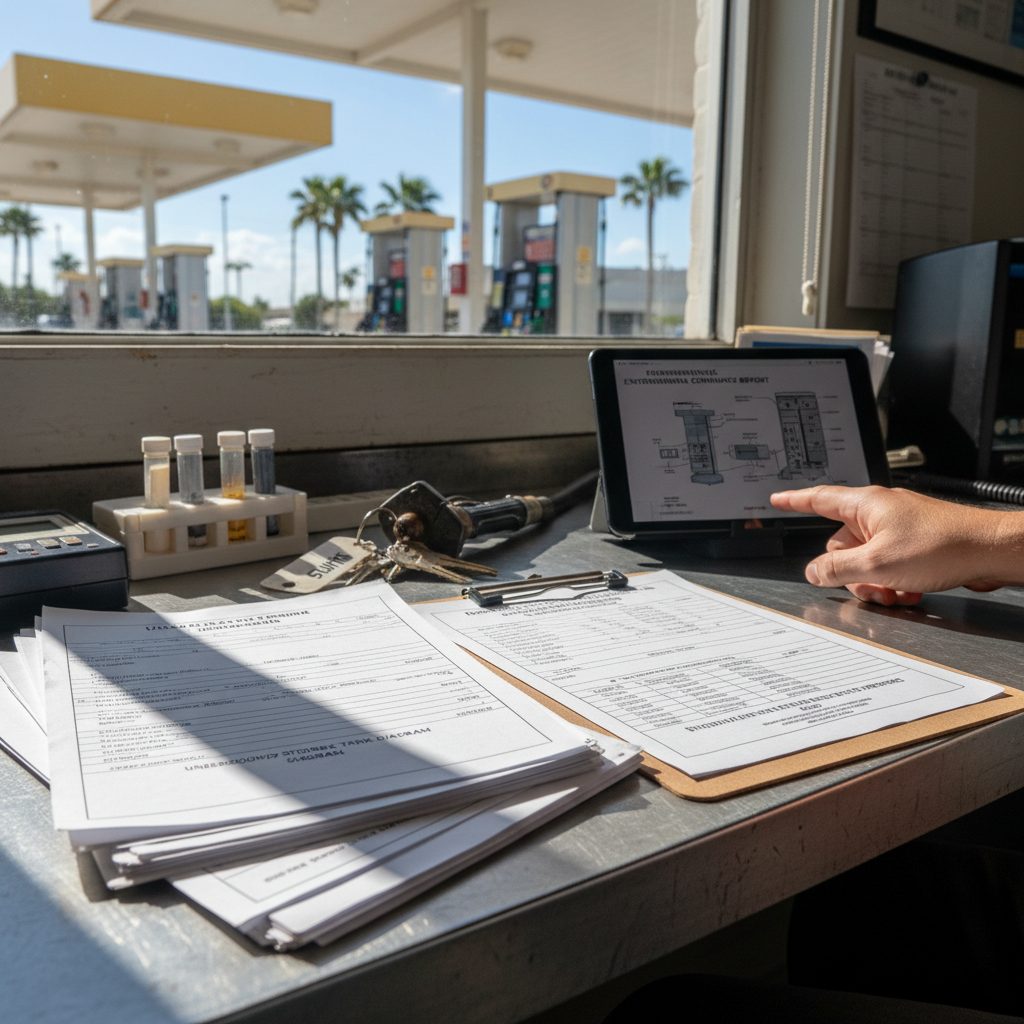
A number is only as good as the records behind it. Buyers, lenders and appraisers will ask for the same file, so gather it before anyone prices the station.
- Supplier gallon reports and fuel invoices for at least two years, ideally three
- POS reports showing inside sales and gross profit by department
- Three years of tax returns and Florida sales tax filings
- The fuel supply agreement, including term, minimum gallons, pricing and any image loan balance
- The lease, if the real estate is not owned
- Tank registration, compliance history and any discharge records
- Payroll detail and a list of upcoming capital needs with contractor quotes
- Any franchise or brand agreements
Then compare the records against each other. Fuel invoices should match POS fuel sales and tax filings. Look at trend and seasonality, and check whether a recent strong quarter came from a temporary price swing. If the books are informal, rebuild them from supplier invoices, bank deposits and POS reports. For the seller side of this file, see financial statements needed to sell a gas station.
Step 3: Normalize the Earnings
Normalized earnings are what a new owner can expect to earn. Start with reported profit, then adjust it.
Every add-back needs support. Ones you cannot document will be removed by the buyer's accountant. Unreported cash income is excluded entirely, not discounted, because it cannot be financed. Our guide to recasting gas station earnings covers add-backs in more detail.
Add back
- Owner compensation above a market manager salary
- Personal expenses run through the business, such as a family vehicle
- Genuine one-time costs, such as a roof replaced once
- Interest, depreciation and amortization
Subtract
- A market salary for a manager, and market wages for family members who work unpaid
- Realistic repair and maintenance, plus a reserve for dispensers, tanks, canopy and coolers
- Property tax reassessed after the sale, and insurance at current market rates
- Credit card fees, freight and supplier terms that belong inside the fuel margin
Step 4: Apply the Right Method to Each Piece
Value the operating business by capitalizing normalized earnings at a rate that reflects its risk: remaining lease and supply term, competition, equipment condition and how much the business depends on the current owner. There is no single industry multiple. The right range depends on how bankable the cash flow is, so be wary of any multiple quoted without those details.
Value owned real estate separately against local commercial comparables, or by capitalizing market rent. If the station is leased to an operator on a net lease, value it as an income property instead. That is the approach used for net-leased gas station real estate.
The same physical station can be worth different amounts as an operator sale, an investment sale or a redevelopment site. Price it for the buyer pool you intend to reach.
Branded versus independent stations
Branded sites with established supply terms are usually underwritten with more confidence by buyers and lenders, though brand obligations carry capital cost. Independent and unbranded stations often have shorter supply terms, no brand traffic and weaker records, which raises the return a buyer requires. Better fuel cost can offset some of that. See branded vs unbranded fuel supply agreements.
When the land is worth more than the business
For many independents, the land and improvements set a floor under the price. In land-constrained parts of Southeast Florida, the value of a corner site for another use, such as a quick-serve restaurant, car wash or quick lube, can exceed what the operating business supports. That changes both the buyer pool and the method. See gas station pad redevelopment.
Step 5: Subtract What Buyers Will Deduct
Buyers price in every cost they will inherit. Sellers who skip this step are usually the ones whose number and the buyer's number never meet.
- Deferred capital: canopy, dispensers, lighting, pavement, coolers and any car wash that is not working
- Tank age and construction, and the remaining useful life of major equipment
- Open or past contamination cases, and whether state cleanup program eligibility transfers
- Short remaining lease or supply term
- Any unamortized image loan balance the buyer must assume or repay
- The cost of correcting compliance gaps
Environmental risk deserves special attention. A defined, quantified cleanup usually costs a buyer far less in price than an undefined risk. A Phase I environmental site assessment, and a Phase II where warranted, should be done before the number is final. Remediation is often handled as a price adjustment or escrow rather than a deal killer. Read environmental due diligence and underground storage tanks and the image loan traps that catch sellers.
Step 6: Check the Number Three Ways
Before committing to a price, test it from different angles. If it fails any of these, revisit the inputs.
- Comparable sales: does the price fit recent sales of similar stations, adjusted for gallons, inside sales, brand, traffic and competition? Price per gallon and price per store square foot are useful checks, not methods.
- Debt coverage: can normalized cash flow pay realistic acquisition debt with a cushion?
- Replacement cost and real estate: what would it cost to permit, build and brand a new site nearby, and does the real estate alone support a meaningful share of the price if the business underperforms?
Location explains much of the gap between stations with similar financials. Traffic counts, visibility, access from the dominant direction of travel, nearby competition and the strength of the trade area all move a site within its comparable range. Two stations with near-identical books on different corridors can be worth very different amounts.
Valuing Your Own Station Before You Sell
If you are selling, run this exercise before you set an asking price, using the same methods your buyer's lender will use. Sellers who price from a neighbor's rumor tend to sit on the market and then reprice after buyers have already judged the listing. A well-documented, realistic price attracts more qualified buyers and holds up through due diligence.
Assemble the support as you go: supplier statements, POS department reports, tax returns, the lease or deed and the tank records. A price you can document survives diligence. A price you cannot document does not. Our guide to selling a gas station in Florida covers the rest of the process.
Broker Opinion of Value or Formal Appraisal?
Both have a place. A broker opinion of value is built from fuel-site comparables and current buyer demand, and it is the practical starting point for pricing, listing strategy or deciding whether to sell at all. A formal appraisal is usually ordered by the buyer's lender during financing.
Convenience stores without fuel follow a related but different method. See convenience store valuation methods.
Frequently Asked Questions
Speak With a Florida Gas Station Specialist
Request a confidential consultation or off-market opportunities and pricing through our contact page, or call +1-305-518-1545. The Gas Station Group is headquartered at 8603 S Dixie Hwy, Miami, FL 33143. Principal: Bobby Berrido.
Continue Reading